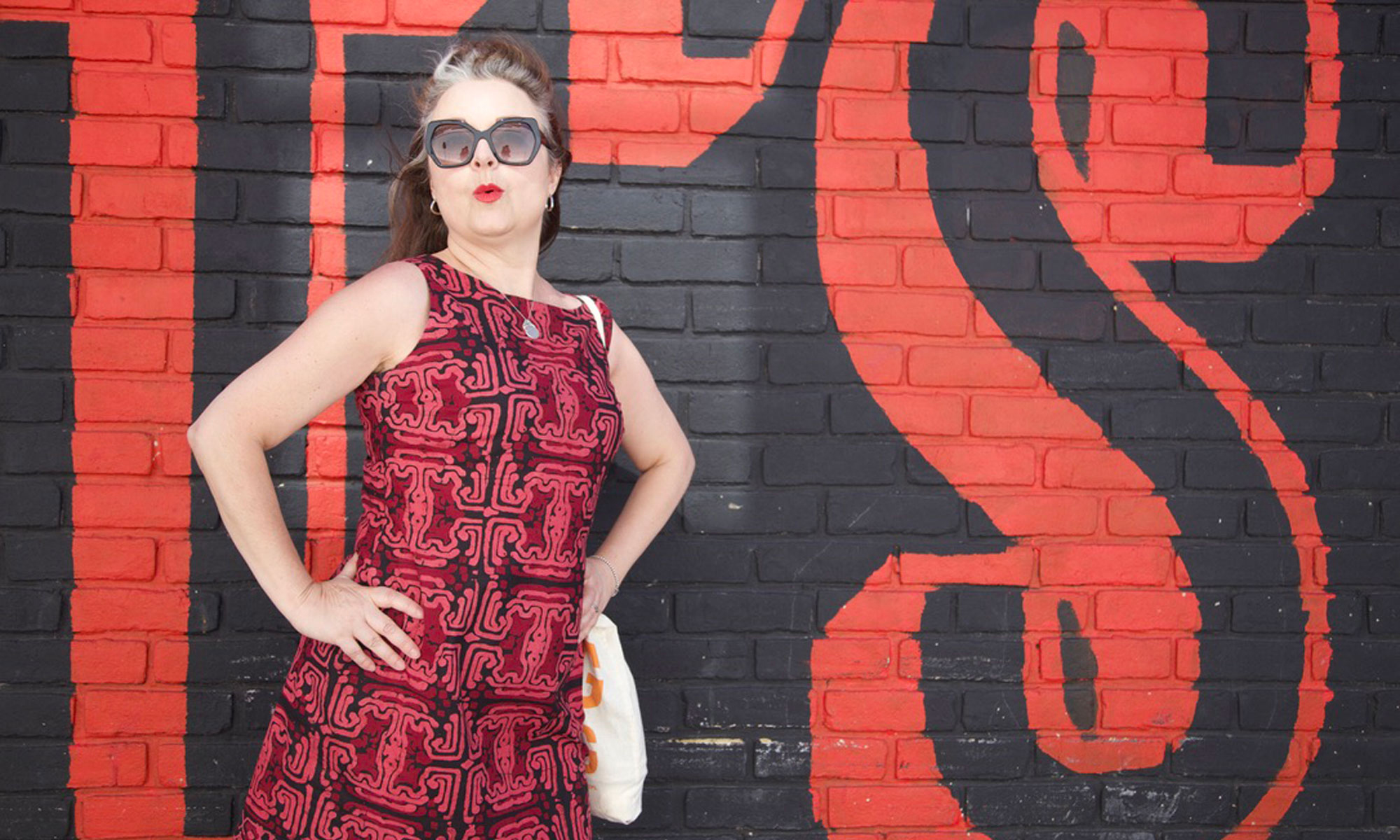
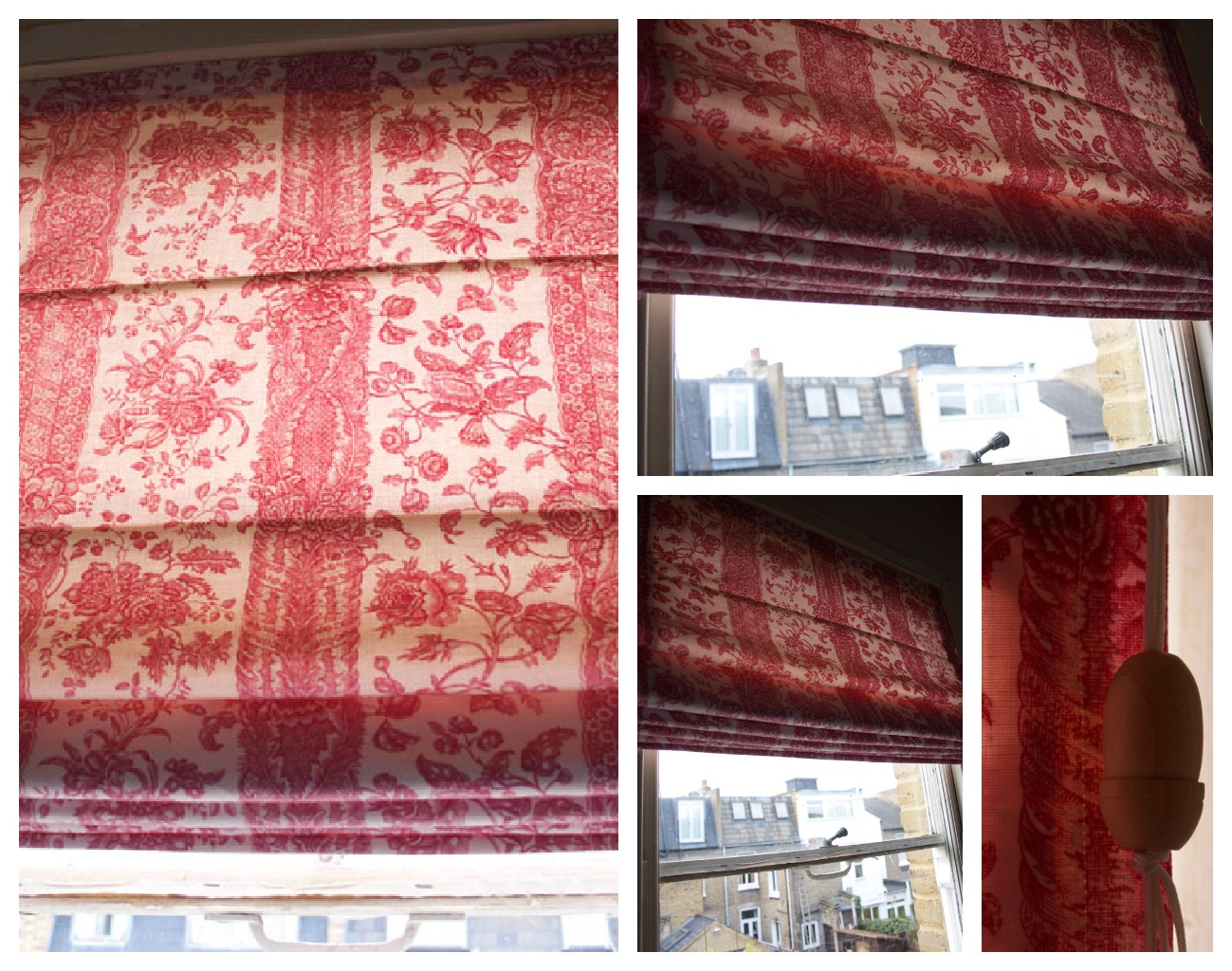
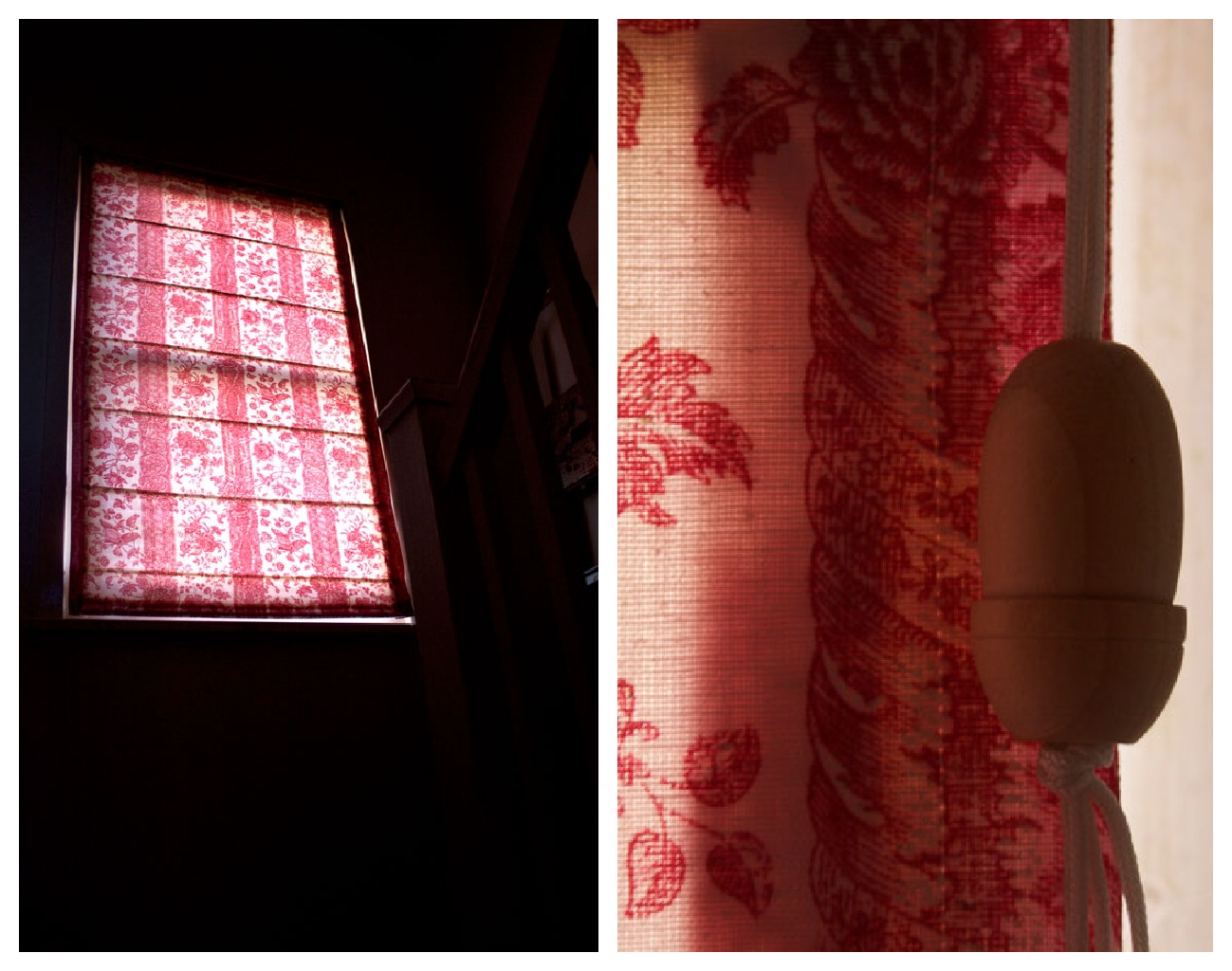
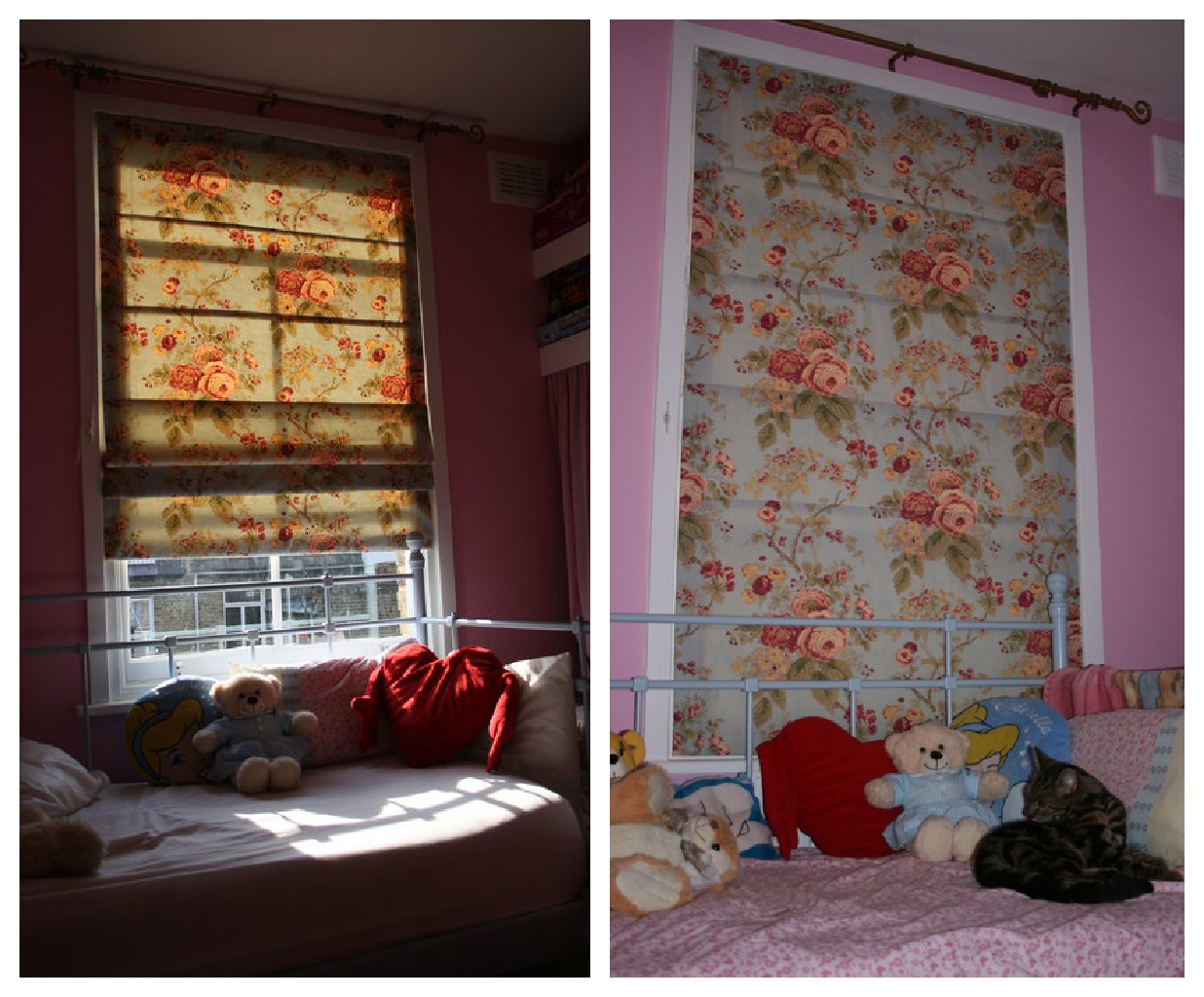
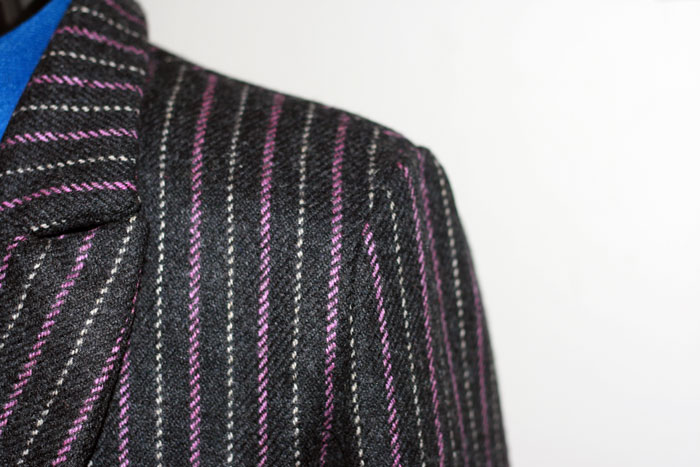
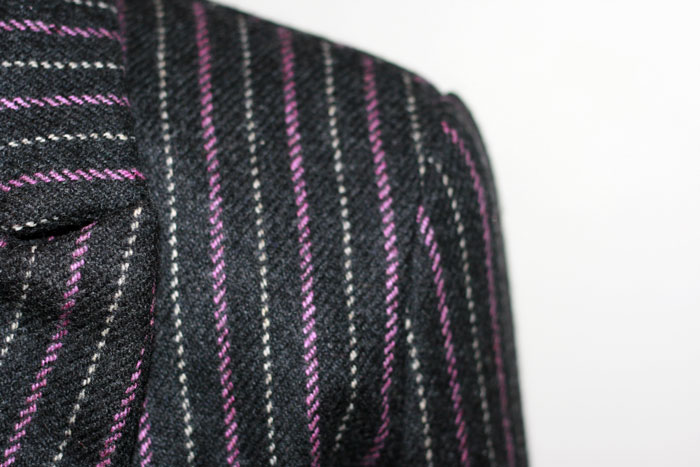
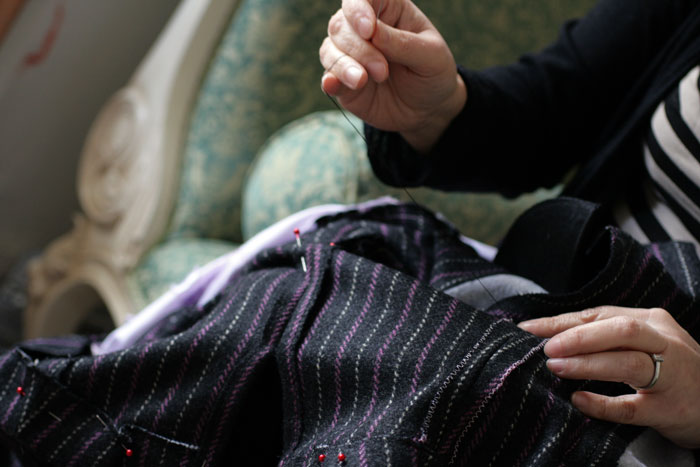
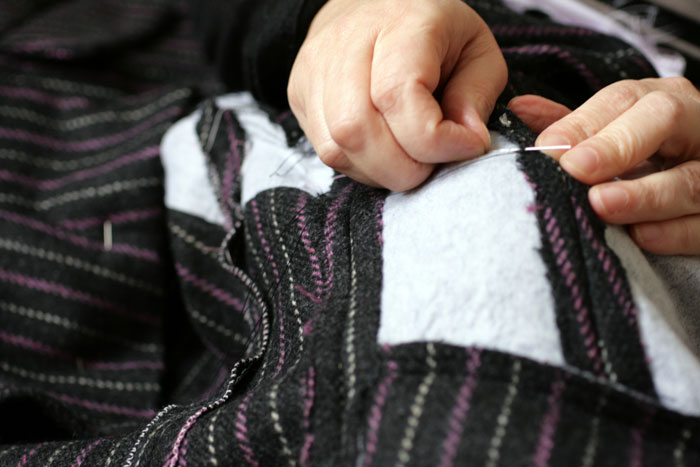
Well I’ve certainly got that winter nesty feeling. Never thought I’d say it but the rain can tip down as much as it likes. The wind can howl till it’s heart content and who cares if it’s cold as a polar bear’s nose. I am happily inside, toasty and warm, making bread, watching old movies, sewing and putting up my freshly made Roman blinds, or Roman shades if you are anywhere but the UK!
I’m assuming the fabric is vintage. It had that musty attic smell about it when I landed 5 metres of it, for £10 at a charity shop. But nothing a spruce in the washing machine couldn’t sort.
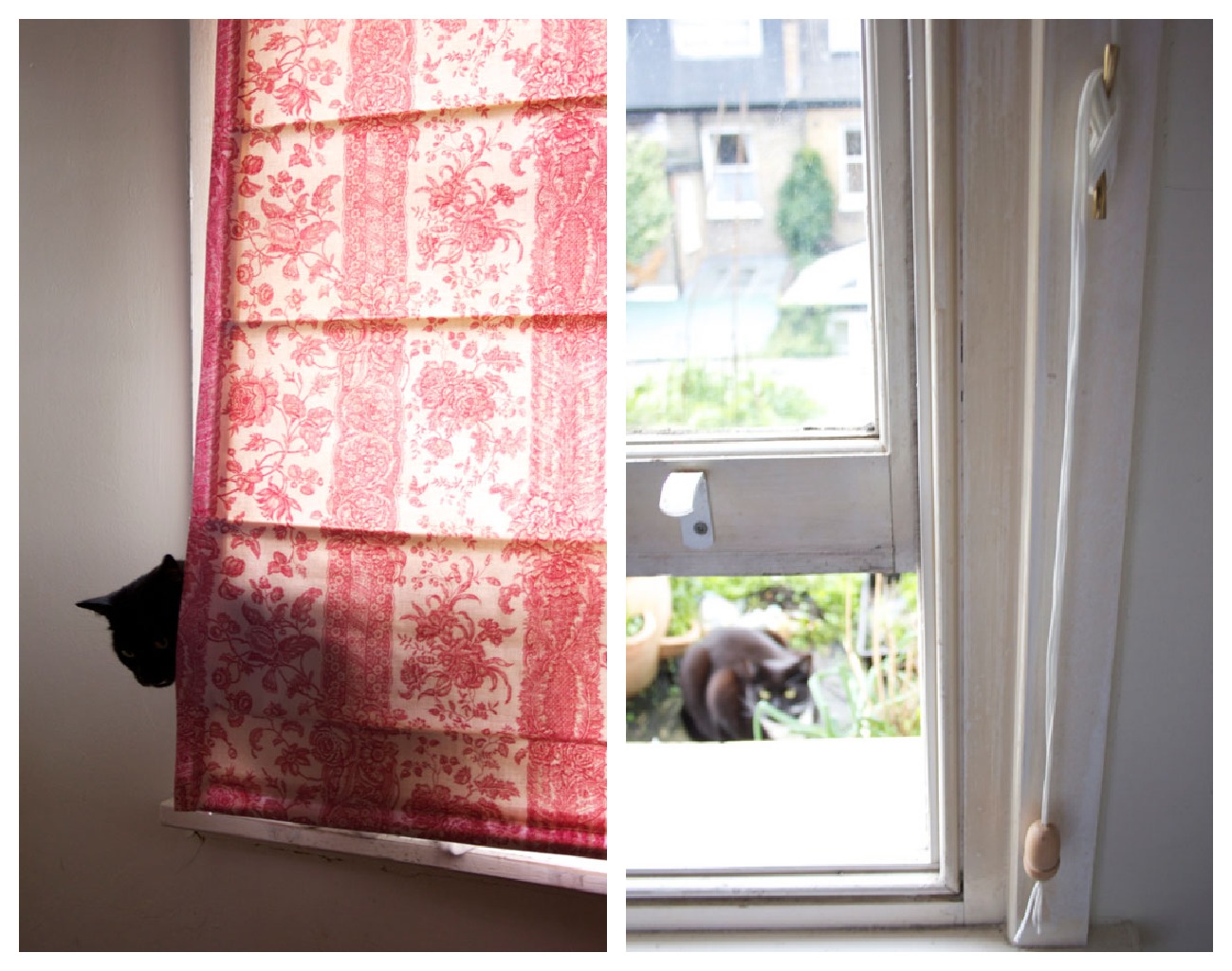
The hardest thing about these darn blinds (or shades) is photographing them! Too light outside and you get too much show through. Too dark and you see nothing!
Too long trying to be arty farty with it all and you get cat-hassle!
I’ve made these on a couple of occasions before but only posted on Burda. This set I made for Little Miss Ooobop’s room using an remnant of fabric I picked up in a discount fabric store for a fiver:
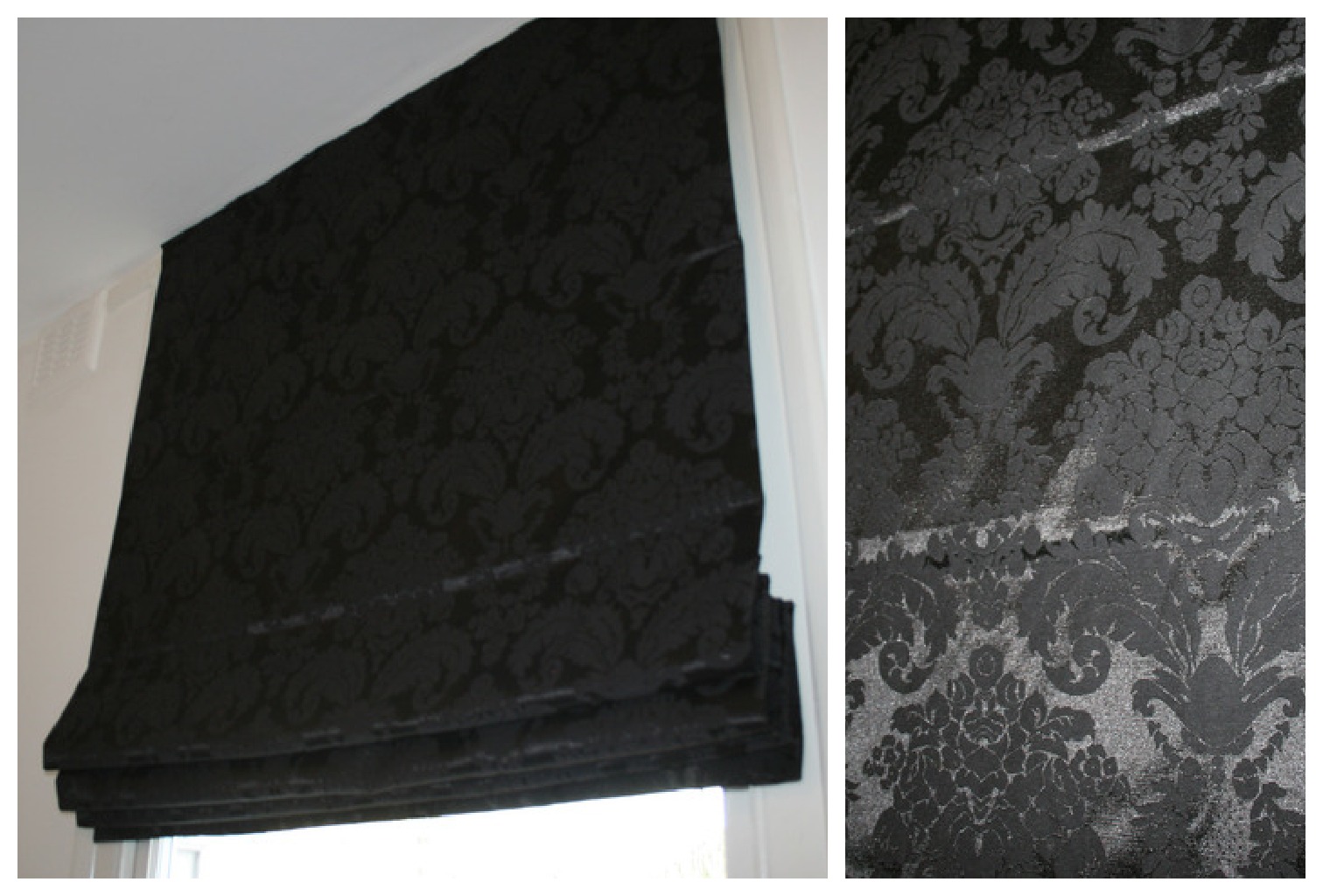
And these black ones I made for my eldest daughter… for considerably more pounds:
This is a great sewing project for a beginner because it only involves sewing in straight lines. But as many times as you make them you still have to measure twice and cut once. Or in my case, five or six times. It’s all in the maths.
For anyone who’s interested I will compile a tutorial. I didn’t take in-progress shots, mainly because I worked in such a horrendous way, spread all out on the living room floor with cats jeopardising the project every step of the way! But I will create some diagrams which should be a lot easier to follow. Just not tonight, ’cause I’m pooped!
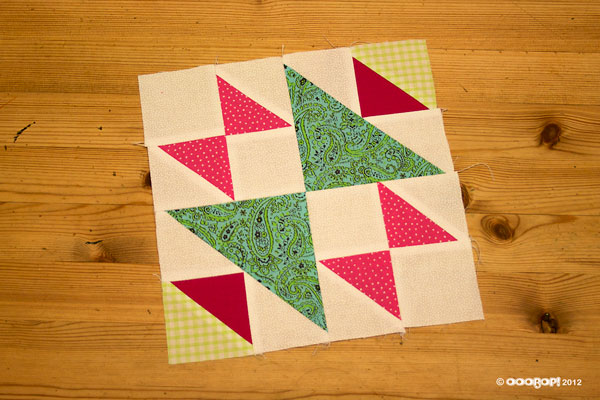
This quilt block is called Old Maid’s Puzzle, though also more recently known as the Bachelorette. It is block number 21 from issue 23 ‘Art of Quilting’.
This is the first of my blocks, so far that incorporate a classic ‘bow’ effect, formed by the points of paired triangles touching centrally.
Though there are lots of pieces, there are no inset seams and so it was pretty straightforward. The only problem I encountered was the triangle points being drawn down into the feed dog a couple of times. I have had this issue before. Not sure how to stop it happening but it seems to happen most if I reinforce the stitch at the beginning. It kind of gets chewed up.
In a nutshell: the pink dotty and white triangles are joined along their diagonals, as are the pomegranate and lime gingham triangles. They are ‘chained’ to make 6 squares. After clipping apart they are given a good pressing. The white squares are seamed alongside the pink dotty sides of the made up squares. Then the rectangles are paired to make ‘bows’. The remaining white triangle pieces are sewn to the pomegranate and lime gingham squares to form a larger triangle and then this triangle is seamed to the larger green paisley triangle. Finally the 4 larger blocks are joined together and the final central seam pressed open.
As with most of the blocks, I’m sure they will work much better when they are in position but I do think this one is one of the more interesting ones. A bit wonky on the edges but I’m sure I can cheat that when I come to do the edging!
Block Facts:
Name: Old Maid’s Puzzle or Bachelorette History: This block features in 19th century Amish quilts Level: Some experience needed to create neat joins where the triangles meet No. of pieces: 22
Was beginning to get a bit anxious about the late appearance of this issue on the shelves of Smiths! But was it worth the wait?…. In my humble opinion, if there is just one great pattern in there it’s worth the cover price. Two and I’m laughing. Three and it’s definitely Christmas. But more than three? Oh yes, yes yes!!
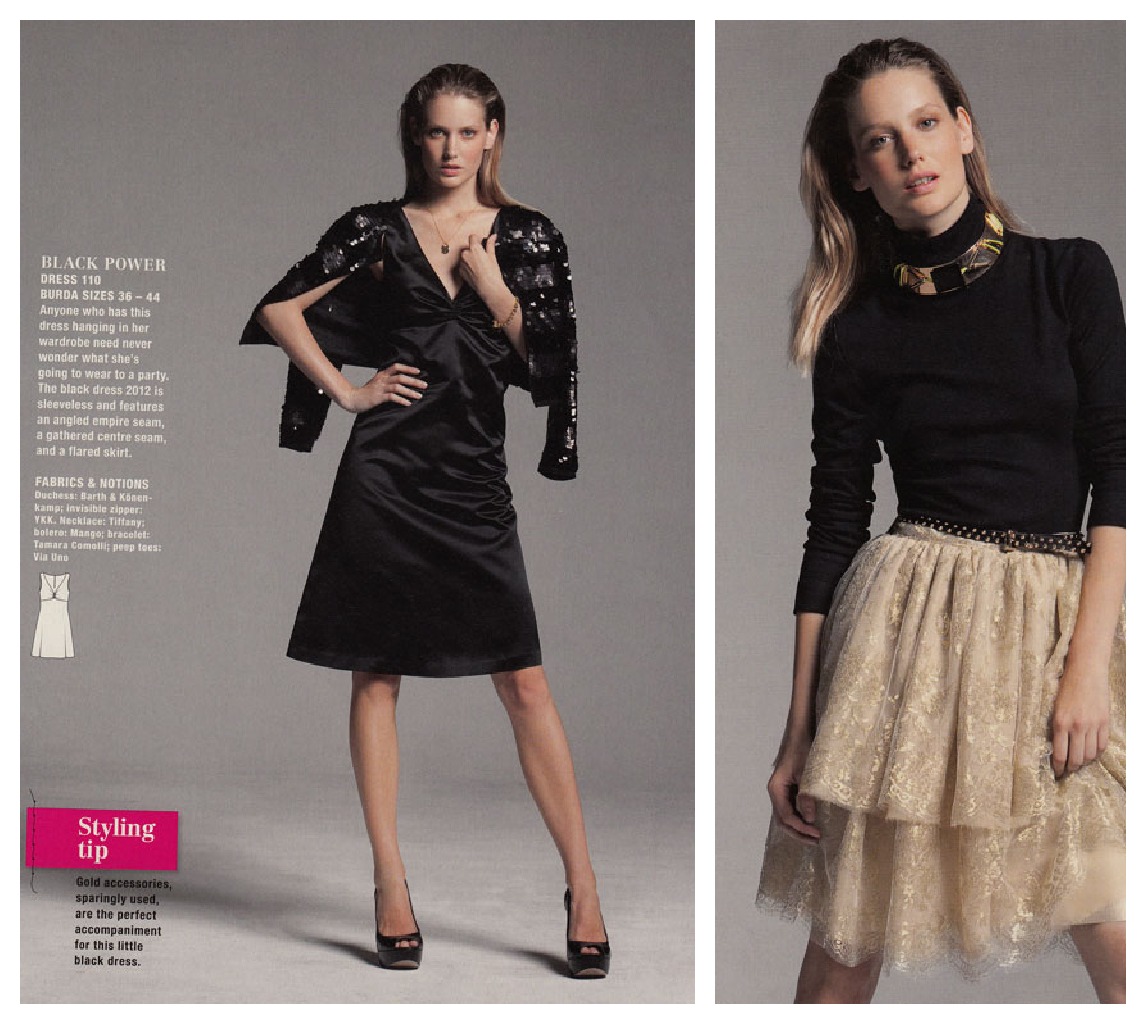
Party Fashions opens with a great fitted jacket in black and gold. Sling it on over a pair of jeans and a T and you are so ready for the party. And check out the detail on the ‘Master Piece’ dress. Hurts my head a bit wondering how that is created. And it has 3.5 ‘difficulty blobs’ out of a possible 4 but as luck would have it, there is a step-by-step sewing course included, to help you on your way.
I love this ‘Black Power’ dress. Shame it is obsured by the jacket in this shot but the line drawing highlights the simple lines. Would be gorgous in silk. In stark contrast, not really a fan of ruffled layered bottom halves. Only because my bottom half doesn’t need bigging up. But this little skirt is pretty with the metallic tulle lace overlay. And incredibly easy to make.
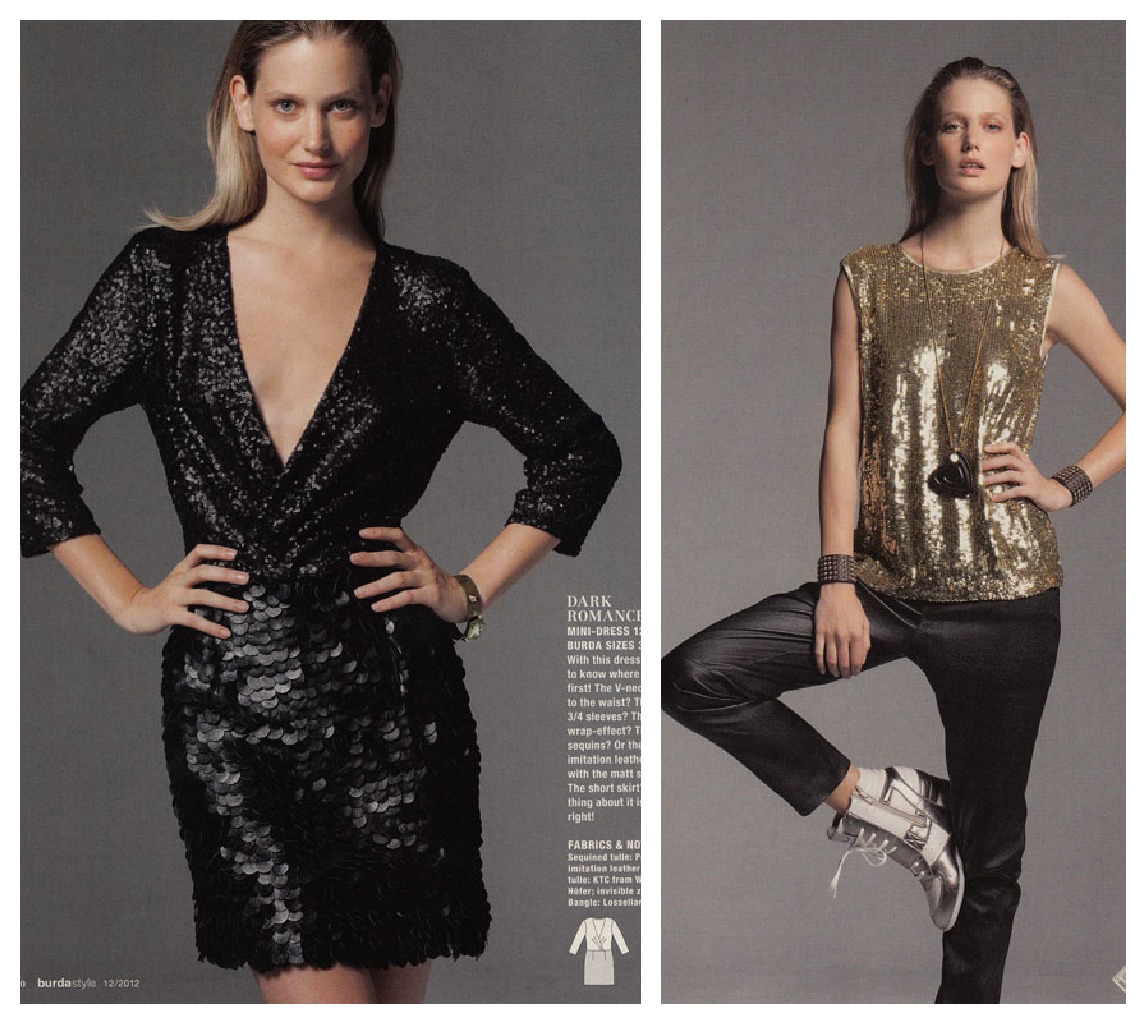
Party Fashions wouldn’t be complete without an adornment of sequins but I can’t help but think how spiky they must be to wear. The skirt part on the black dress however is made from imitation leather scales. Now your’e talking! I don’t tend to do trousers anymore either but stretch nappa leather ones like these are luring me back!
More sequins and shine…
…. and then we are on to Christmas!!
Boy am I excited about this coat. I was given a decent length of a lime green/chocolate shot silk/wool mix fabric. Quite heavy. Probably intended for furnishing. Certainly not dressmaking. But I instantly had visions of classy and totally original coat. Have been looking for the perfect one. And now, as if by magic, I think I have found it! Just praying there is enough fabric!
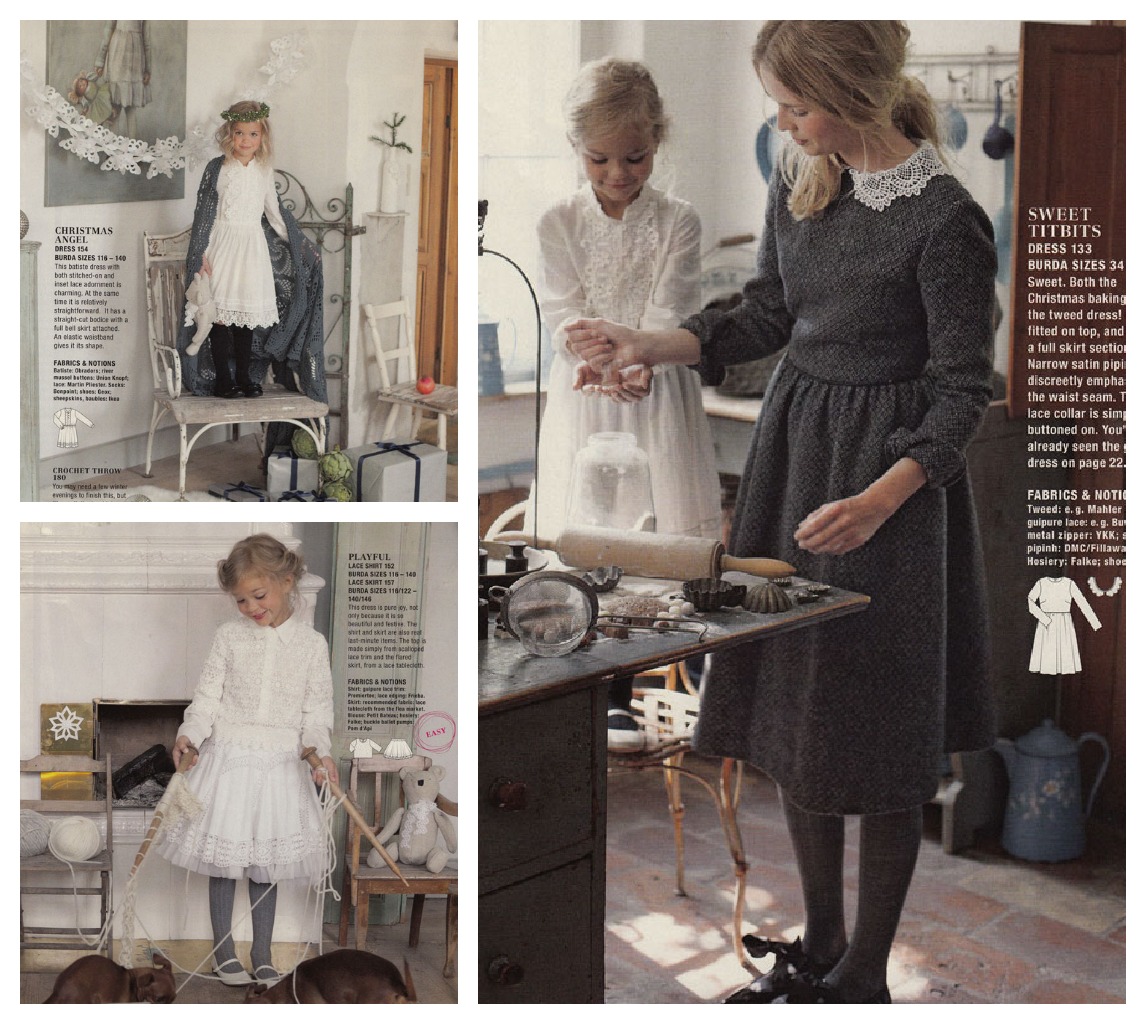
Not sure if I am suited to the following look, though I think the skirt is very interesting. Perhaps its the distraction of the 1D lookalike in the photo. I do however, reeeaaallly like that little girl’s shift dress. And love that it is actually in my daughter’s size. More often than not, the kids patterns are either too small or too large and I’m far too lazy busy for pattern grading!
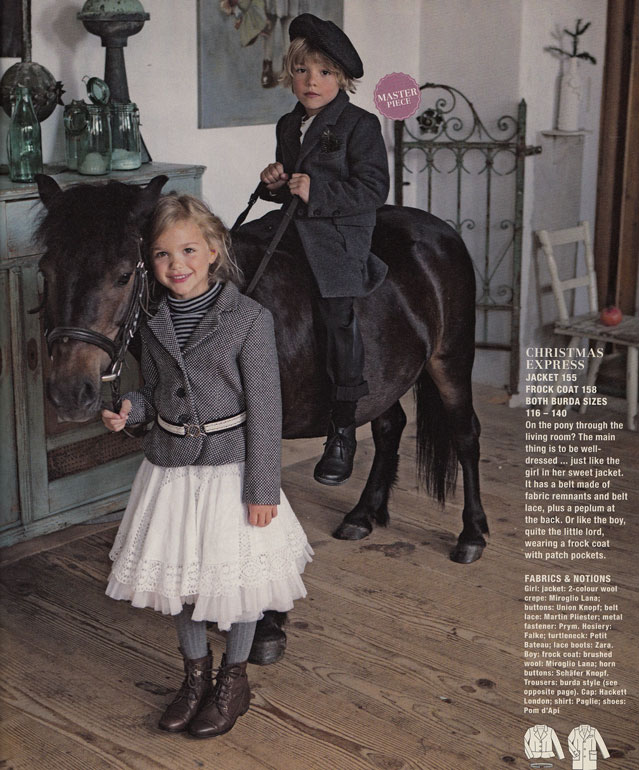
Again. I’m not feeling the puritan look but the jacket with the retro peplum and the little girls coat is totally up my street!
The whole sweet angel and tweed look is maybe pushing the boundaries of sweet. Verging almost on sickly, I’d say! I can hear Mr and Master Ooobop! roaring with laughter as LMO and myself prepare Christmas lunch in such puritanical stylee. The fact that LMO would howl with protest if every I tried to dress her like this is a sure thing too!
A good teddy bear pattern always comes in handy as a gift for a small person. Or even a grown up! I do enjoy sewing toys just as much but so far haven’t strayed from the path of Tilda makes. Burda have even included the corochet pattern for the lovely shawl they are sitting on. Oh please don’t get me side-tracked!
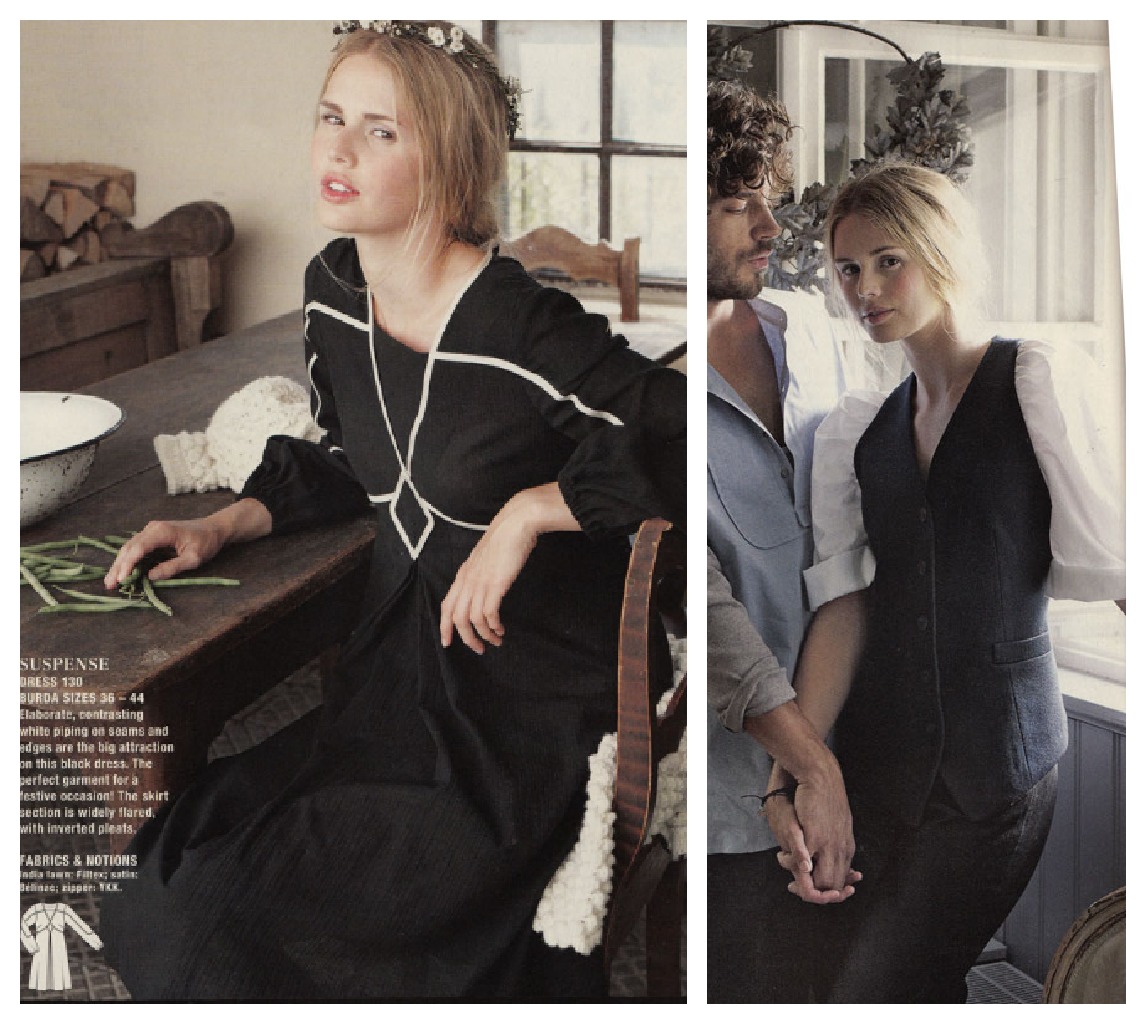
I keep coming back to this dress. It’s not instantly my thing but I love how the seam joins have been highlighted in white. Definitely a conversation piece. I quite like the waiscoat too but they can keep their billowy sleeves!
There’s a Master Piece jacket and coat pattern for the smalls too. Very classy. I’m sure I could talk LMO into that jacket, if it meant she could keep her Doc Martens on too!
There’s a fun Street Style section with some clever twists on casual using wool. Makes for a more quality look than with the usual jersey. But I have glossed over that because I don’t really do casual street!
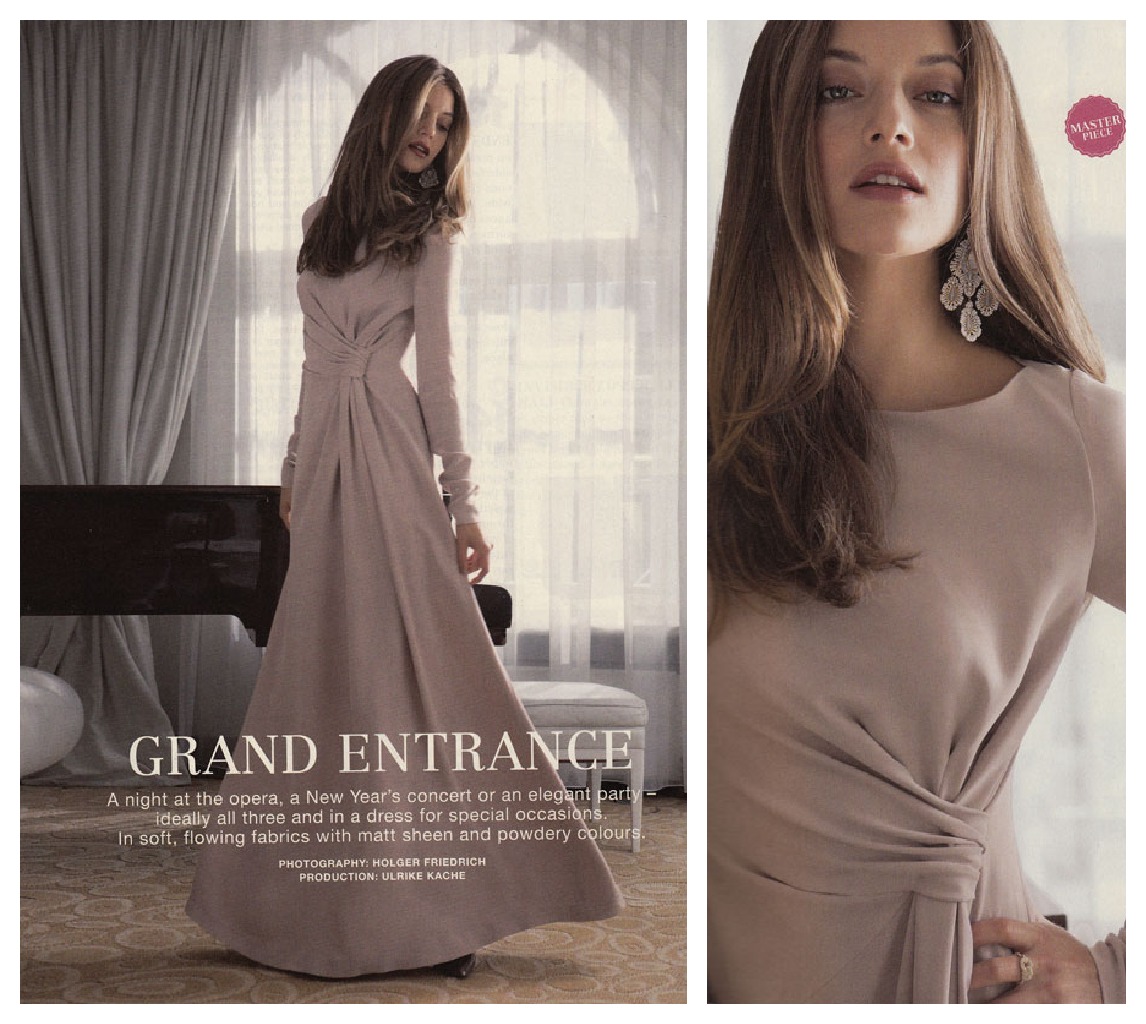
This dress certainly makes a ‘Grand Entrance’ when you turn to this spread. Works great as a short dress but soooo elegant as a full length evening dress. It’s made in silk crepe here. Imagine how luxurious it would feel too!
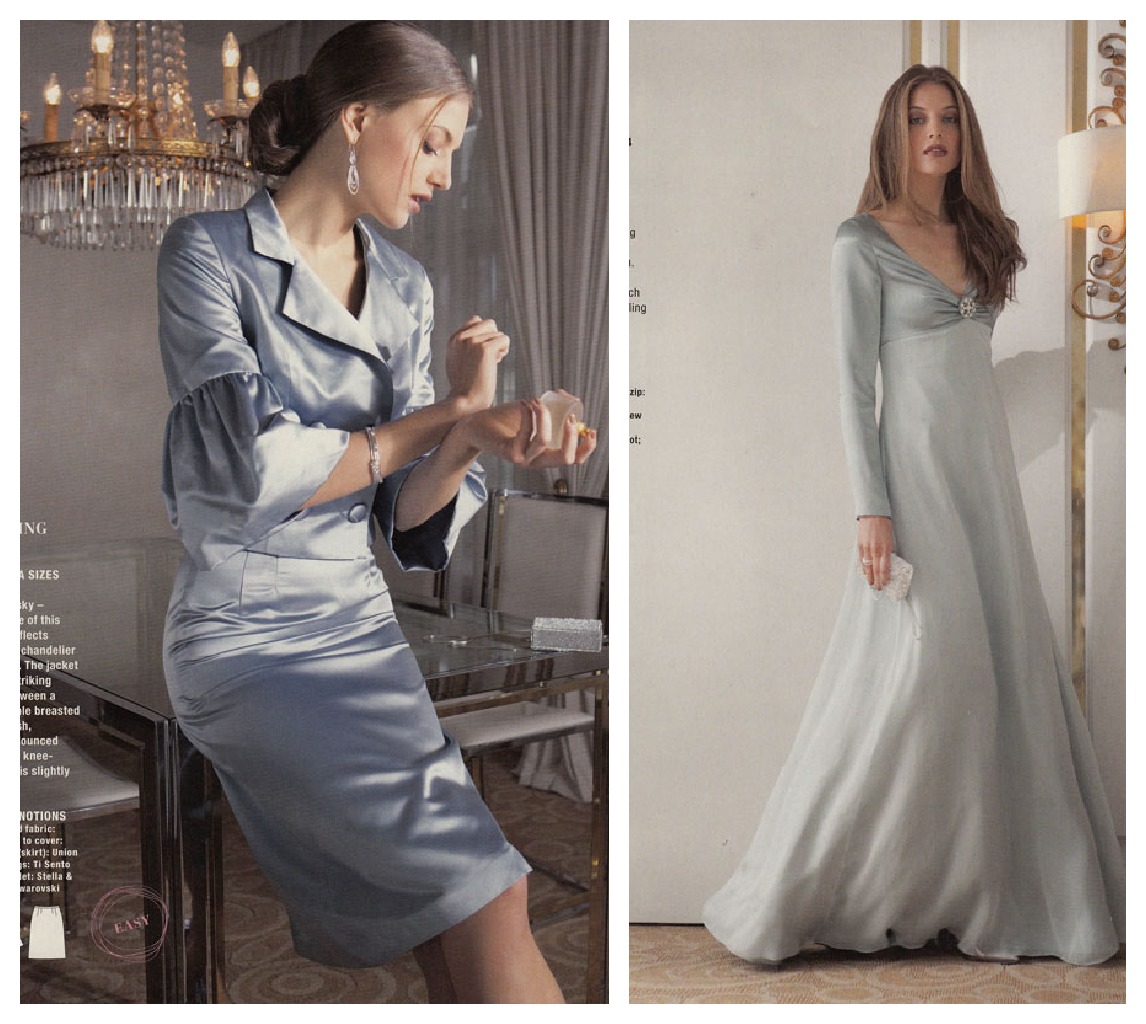
In stark contrast I fear the blue shiny combo on the left is a bit wrong! Luckily there is a pleasant distraction opposite! I really like the simple cut of this dress. A variation of the black dress at the beginning. But with the addition of long sleeves and an overlay of floaty chiffon it is transformed into and enchanting swoosh of loveliness! I do have a little issue with how the neckline seems to be pulling though. Anyone know why this might be happening?
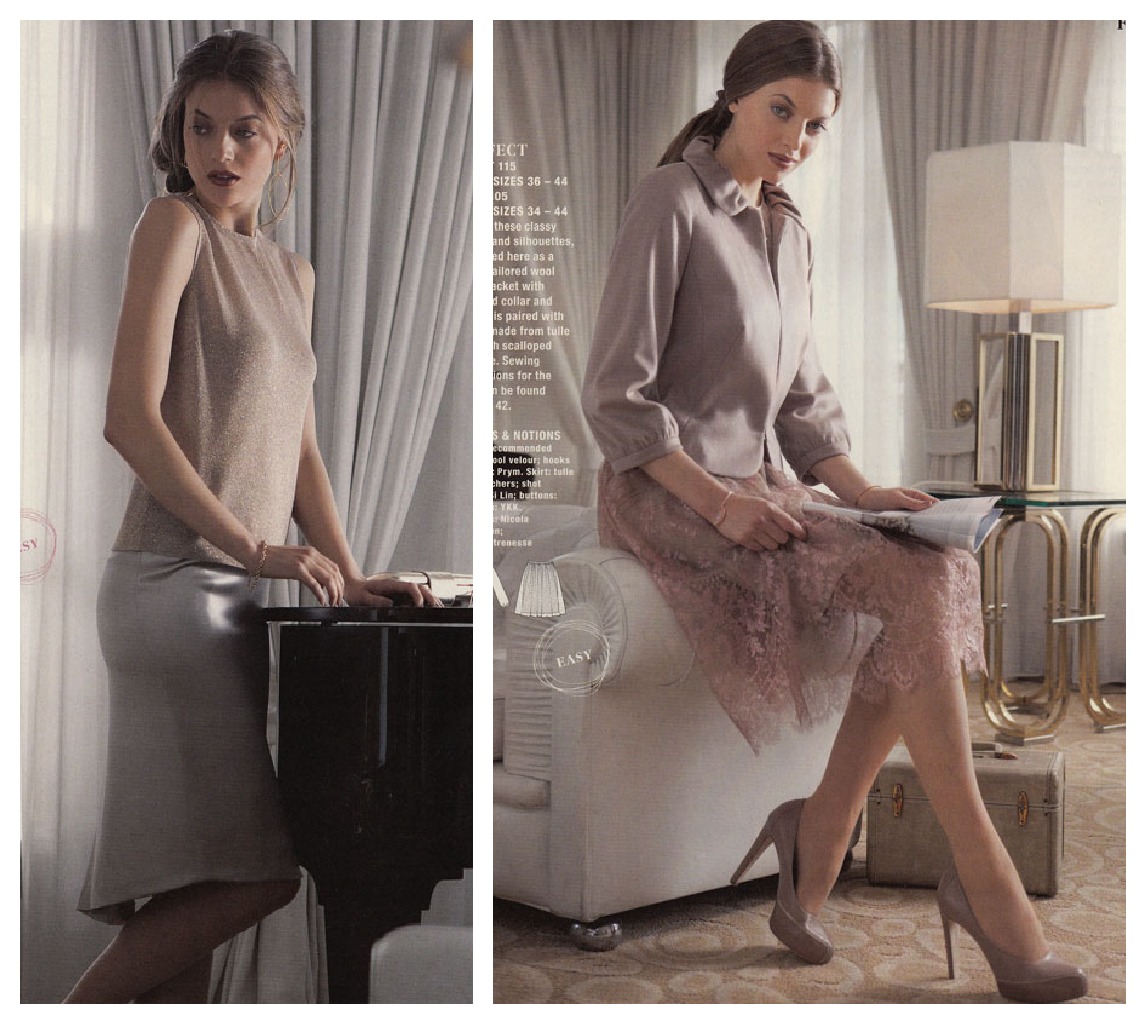
Here’s a couple of real simple to put together outfits. Well, Im sure the jacket is a little trickier but I do think it would be worth any amount of hassle to be snuggled in wool velour. The gathered collar and three-quarter sleeves are gorgeous features. Rose and gold is quite a sophisticated colour combo too.
Oh and here we are. My favourite bit! The Vintage pattern. A very stylish French couture look. Though I like a nice bouclé fabric, especially one with a metallic thread, I think that gorgeous design feature at the front bodice is lost. If or rather when I get round to making this beauty I will definitely be employing a plainer wool fabric and keep it closer to the original.
There’s a few treats in the plus section. Not least of all this hot LBD. Flattering sweetheart neckline and some glamourous gathering at the hip. Oh to have those curves!
Well that just about wraps it up for the clothes section but there are lots of extra crafty projects too, just to get you in the spirit of the season!
Thanks for swinging by. Hope you get some sewing in over this busy time. Till next time, toodlepip! xxx
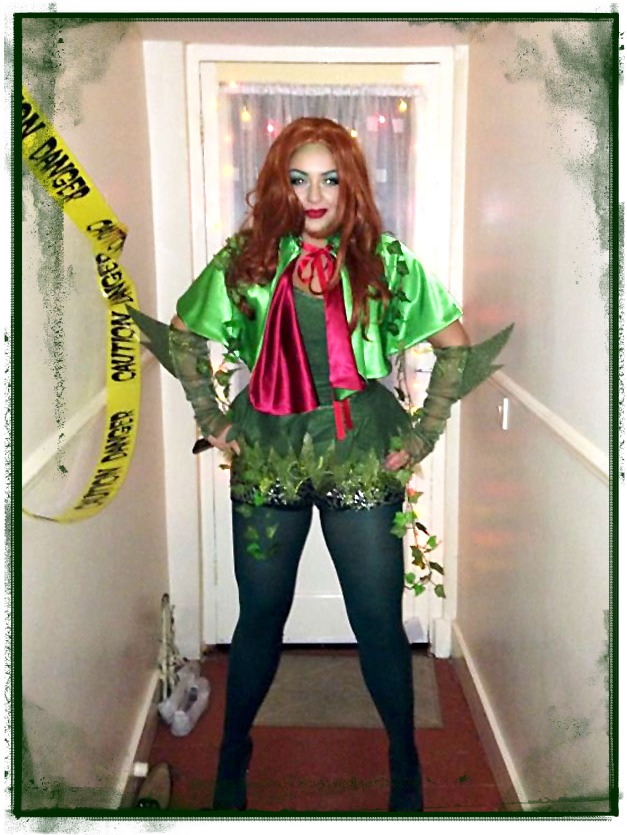
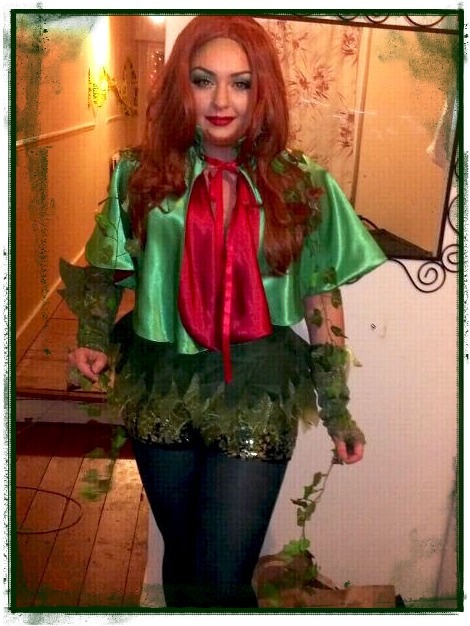
Meet my biggest little girl! Hardly a villain but seriously rocking the whole Poison Ivy thing!
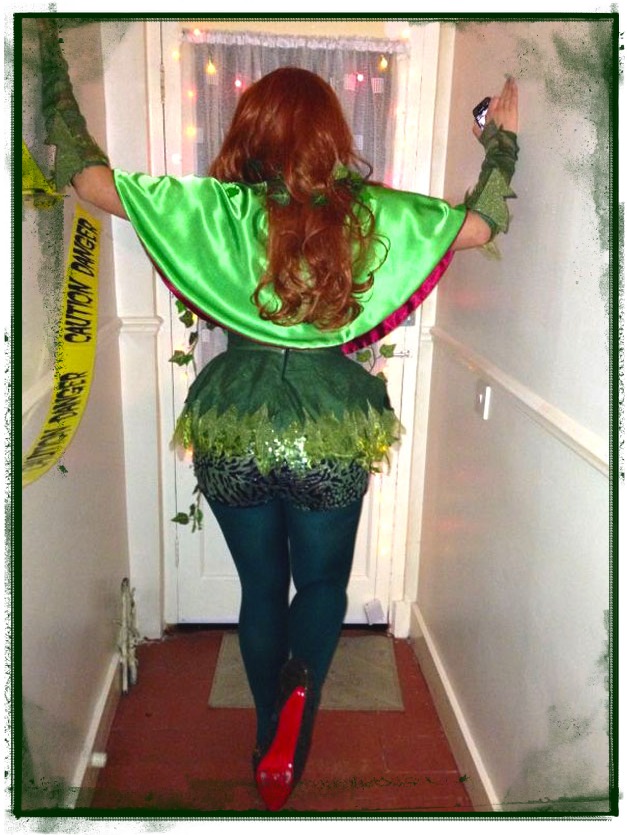
It’s not often I get asked to contribute to her wardrobe. It is in fact never! So I was very honoured by the request to make a capelet for her Halloween costume. Yes I know this is a bit late in the day, soz, but I wasn’t allowed a sneak preview on the day (something to do with me being an embarrassing mum at her last party I would think!) and had to wait patiently for photographic evidence so I could share it with you.
It was a very fun and quick project and even ‘biggest little’ was impressed! If you knew her like I do you would know how amazing that is!
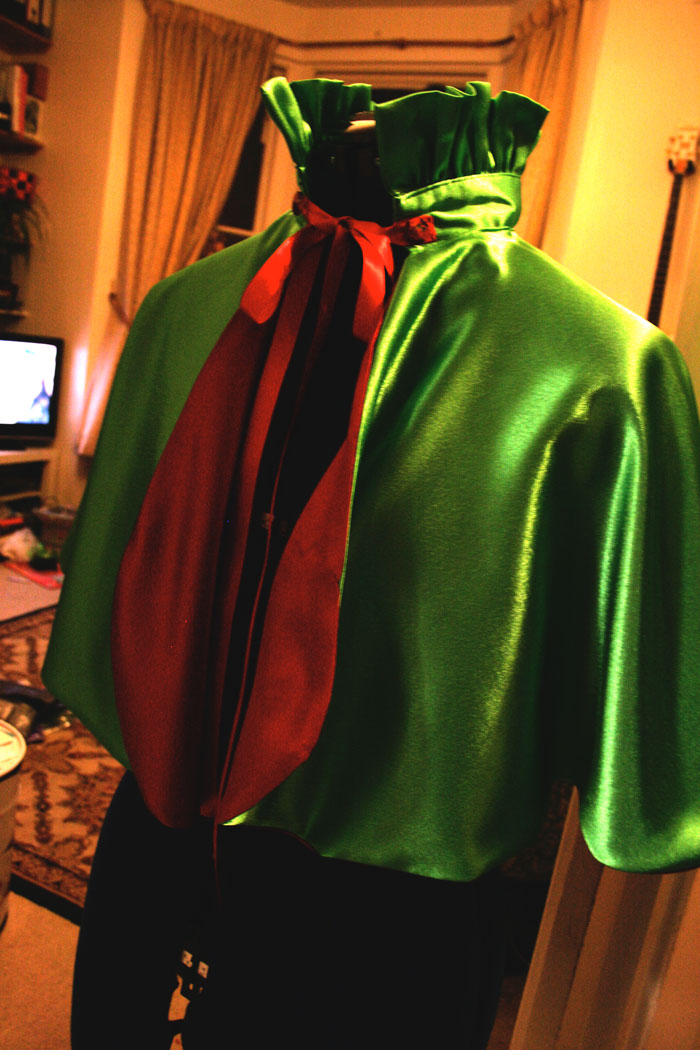
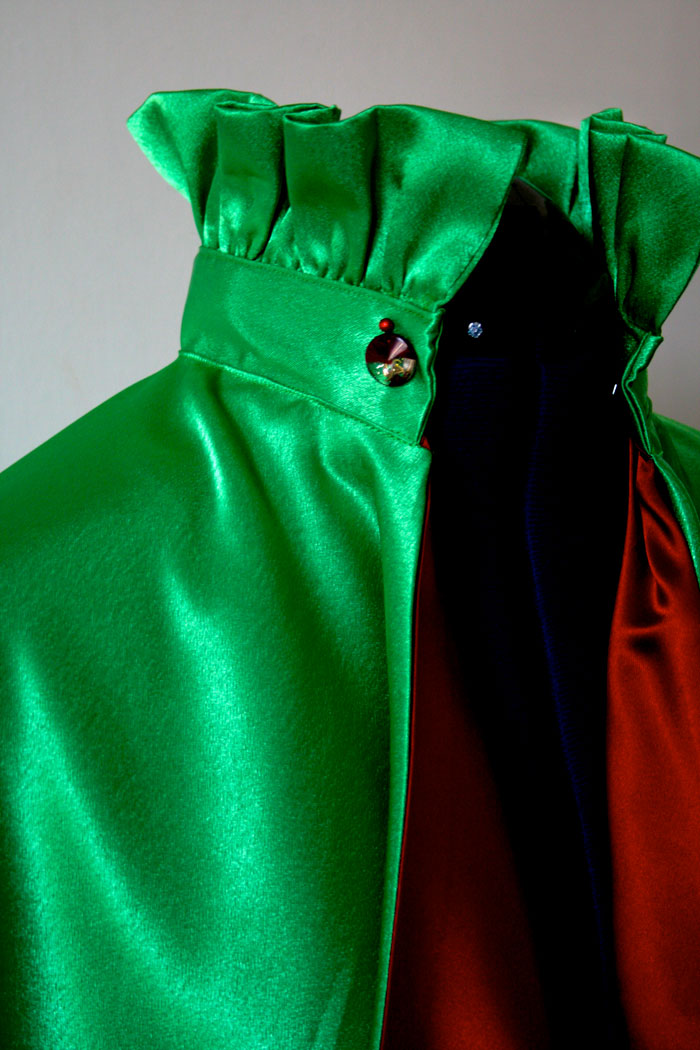
Here’s a better picture of the stand-up collar. You cant see it for all the red luscious locks!
The exterior is a bright green poly satin fabric with red satin lining and I used some glitzy buttons at the neck to cover the ends of the ribbon. Should have sewn them in the collar stand really!
It was a very simple project for quite an effective fancy dress accessory…
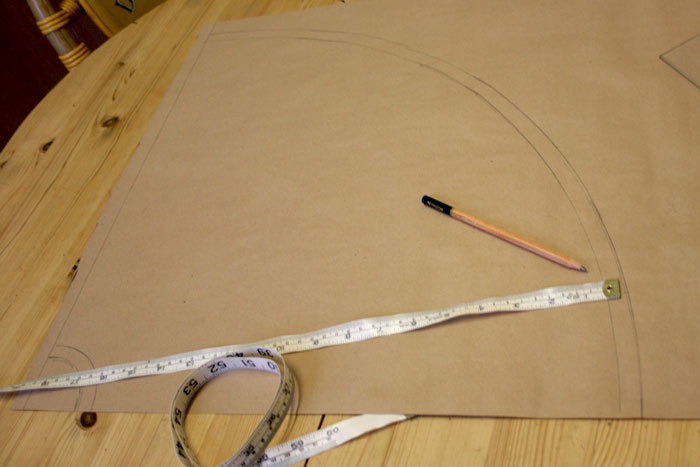
First I measured the neck (plus ease) and the measurement from the neck, over the shoulder to just below the elbow. Using Pi (22/7) I worked out the radius to draw the neck hole and from that circumference I could mark the length of the capelet and draw the circumference at the hem (plus SA)
Have you ever wondered what that little hole is for at the end of your tape measure? Well I sure have found a use. If you position and hold down the tape measure at the distance required, on the centre point, or corner of your paper, you can put the point of a pencil in the hole at the other end and draw the arc of the circle. Its not as accurate as a compass but I don’t have a set of compasses that large and this method was good enough!
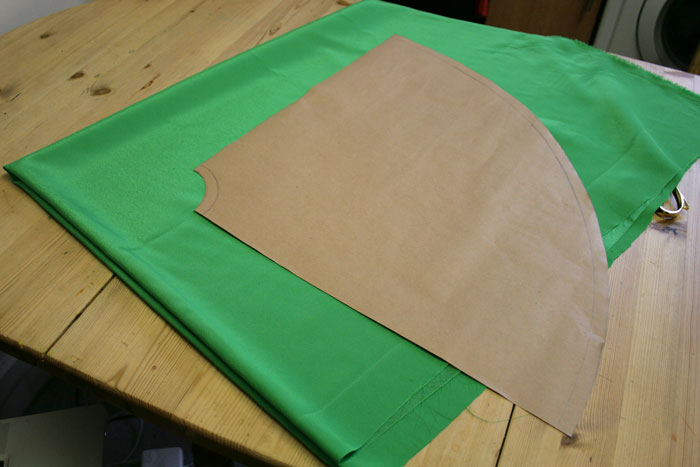
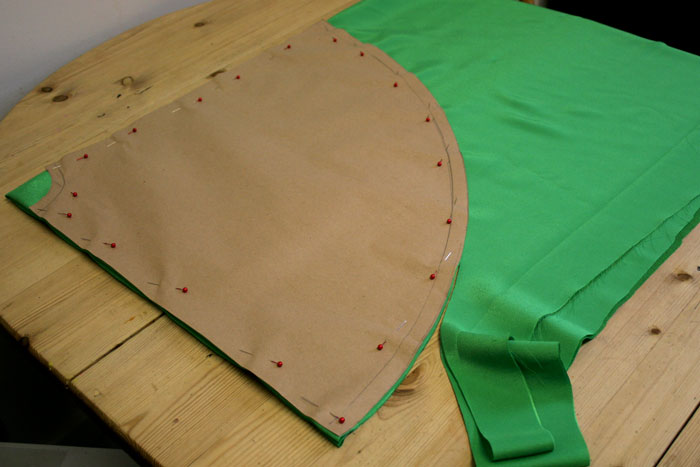
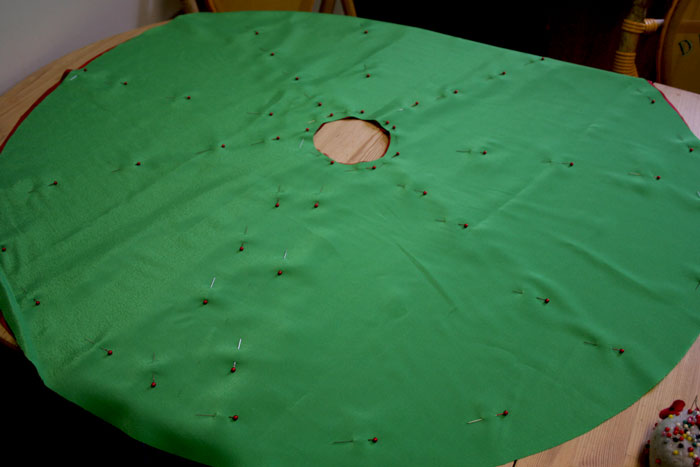
I folded the fabric into quarters and pinned the pattern, making sure it was butted to both adjacent sides.
I did the same with the lining and cut out. This is not my favourite fabric to work with, I hasten to add!
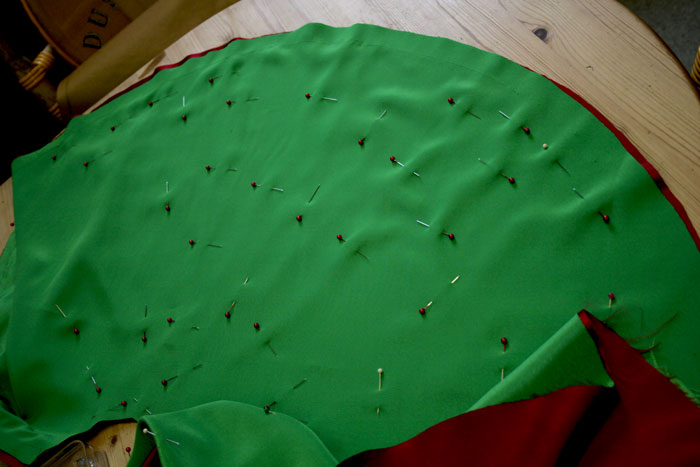
Next up, I pinned the self to the lining, right sides together, using lots and lots of pins. I am telling you, this is soooo not my favourite fabric to work with. It slipped and slid all over the place!
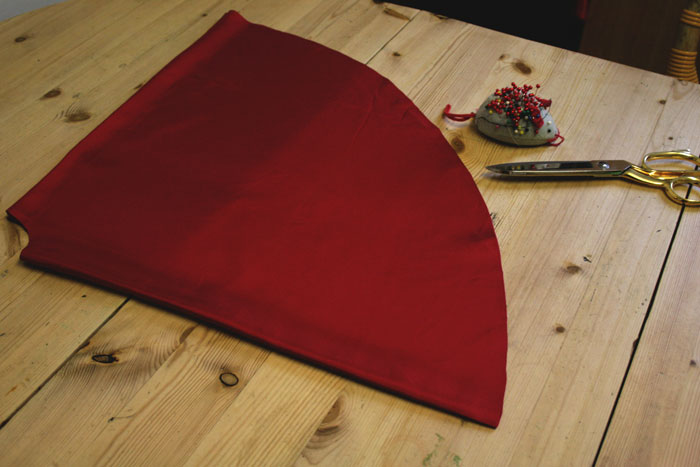
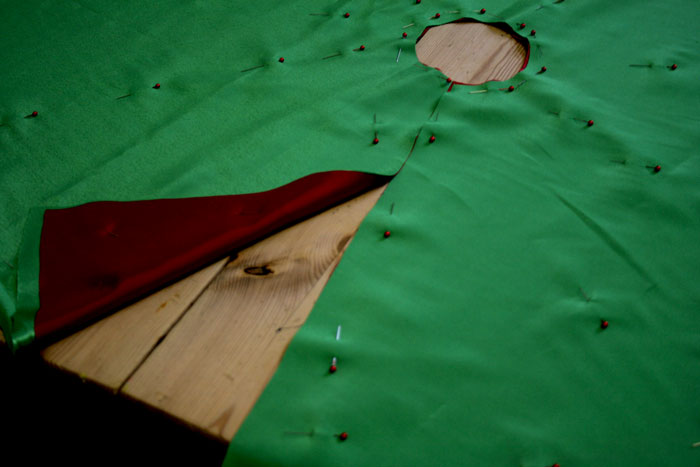
Then I cut the front opening. You can see just how far out I was with the cutting/positioning of this slippery stuff!
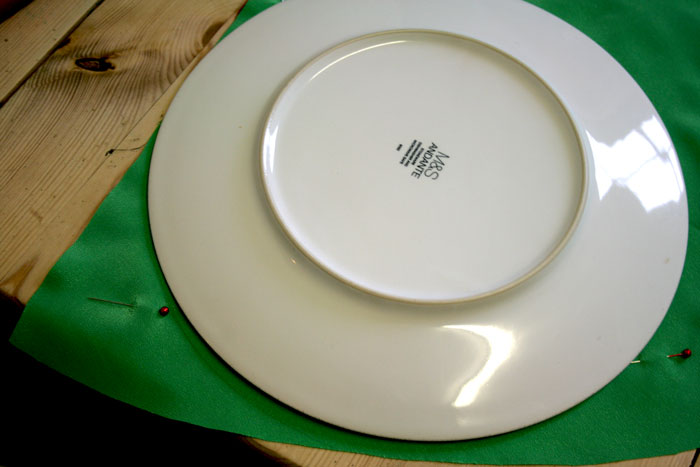
But I saved the situation with a genius idea to round off the corners! And note my next exclusive dressmaking tool…. a dinner plate!
I stuck in some more pins before I attempted to sew around the base hem and up the front openings. But it still took 3 or 4 attempts. It was like a couple of magnets repelling against each other!
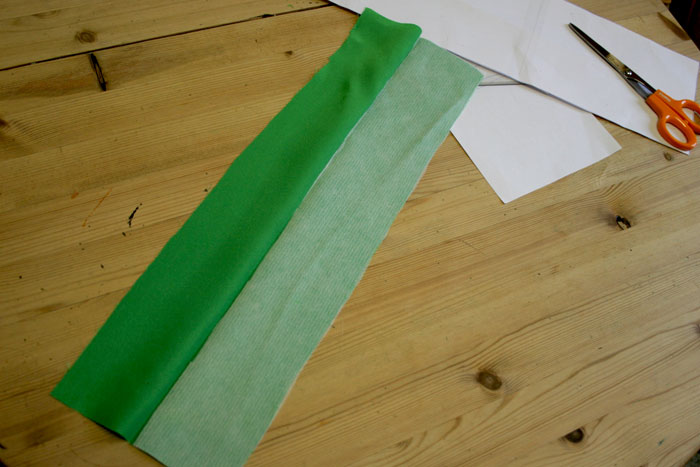
I left the neckline open while I constructed the collar. First I made the collar stand. The measurement for which was the neck measurement (plus ease) by 5 inches (I think!)
I folded it in half, lengthwise and applied fusible interfacing to one side.
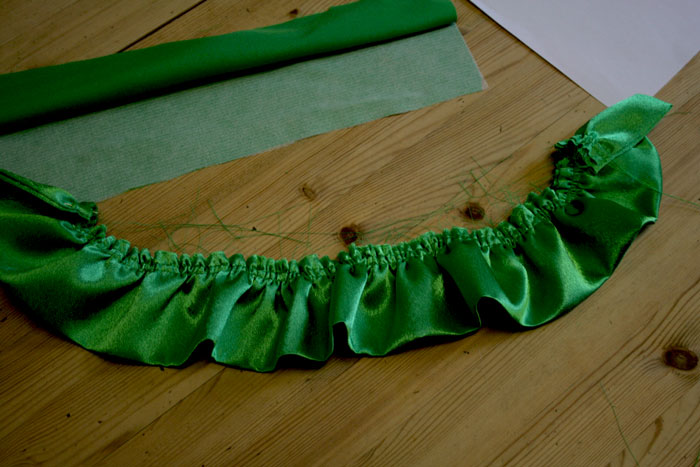
To make the ruffle, I cut a strip the same width only twice as long, folded, pressed and seamed the short ends, right sides facing. I gathered the raw edges to the same length as the collar stand.
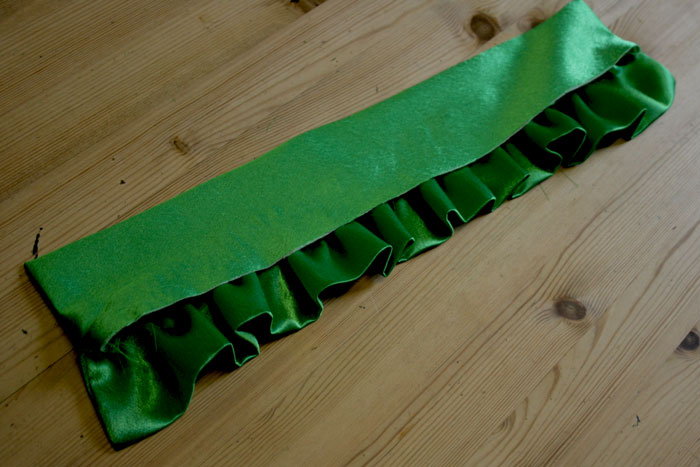
I don’t have pics for the next stage but hopefully it will make sense. I sewed the short ends of the collar stand together and turned right side out. Matching raw edges, I pinned the ruffle to one side of the collar stand, right sides together, careful not to catch the underside.
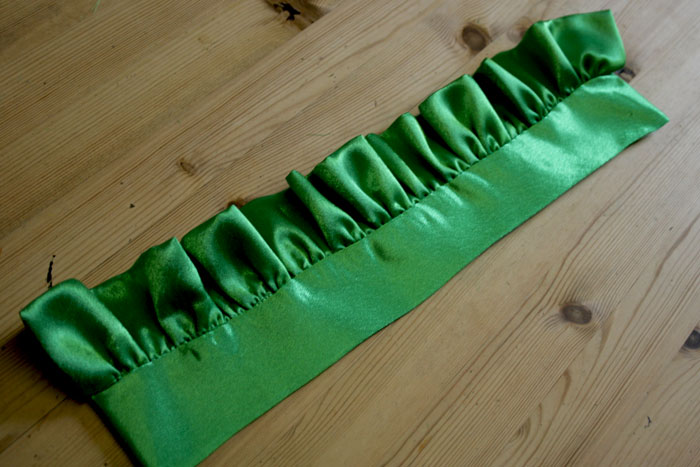
I turned the ruffle up, hiding the raw edges inside and gave it a press to keep it in place. I then folded in the seam allowance from the remaining side and topstitched in place.
Again I am missing a few pics, but to finish off I sewed the base of the collar stand (the folded edge), right sides facing, to the neckline of the self side of the cape. I then folded and pressed in the seam allowance on the lining and top stitched to the other side of the collar, very close to the edge.
Buttons and ribbons were then sewn in place.
Hope this gives you some insight. So sorry for the missing pics. I will be more diligent with my tutes next time!
This is indeed a very fun and quick make… but I would advise a woven fabric just for sanity’s sake!
I have been seriously neglecting my quilt blocks of late. Am more behind than ever but heyho… I will have a lovely quilt on my bed one day. Just not some day soon!
Introducing the Whirligig block, number 20 from issue 22 ‘Art of Quilting’. Though issue 21 supplies the batting and instructions on how to join the first 6 blocks, I feel the need to get a few more blocks underway first.
Inset seams are second nature now. Not so daunting any more. Which is lucky because there are a few involved here!
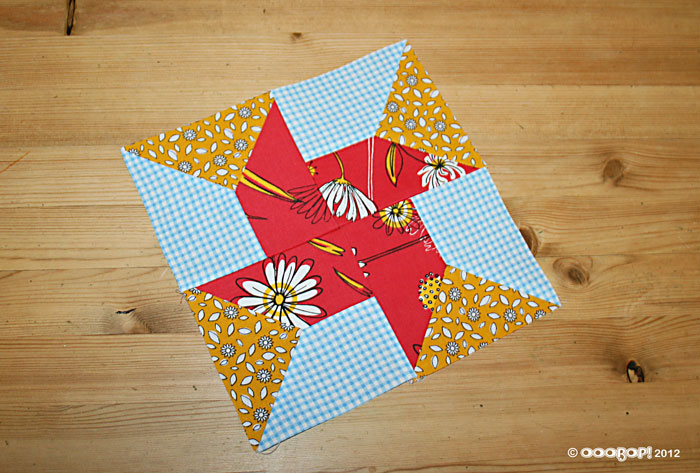
The ‘orange blossom’ triangles are first sewn to the gingham pieces. Important to mark the 6mm seam allowance on the triangles before making the first seam. Then you know at what point to stop, where the seams meet. The ‘red daisy’ pieces are then joined to the triangles and then the final seam to the blue gingham completes a quarter of the main block. Once they have been arranged in position, the bottom two quarters are seamed together and then the top two. They can be chained and then snipped apart. Finally the two halves are joined together and the centre seam pressed open with the ‘toe’ of the iron.
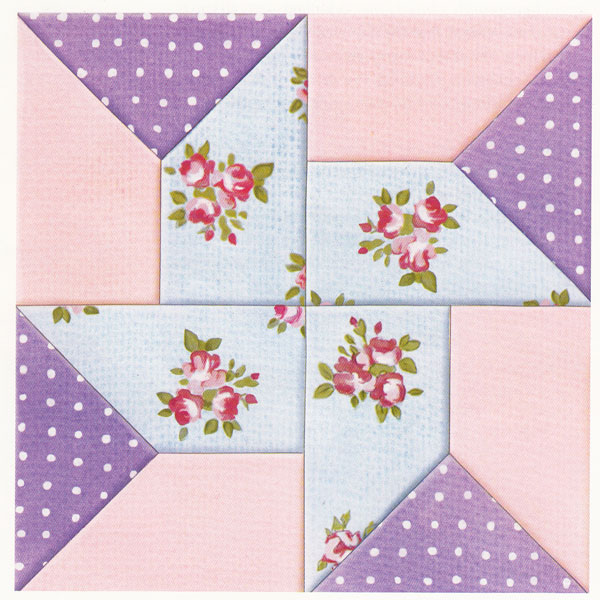
I have to say this is my least favourite block so far. I think its the fabric colours. They create such a clumsy shape. I did consider selecting different fabrics but I wanted it to be consistent with the rest. The design is meant to be characteristic of the propeller look but it is very interesting how the design changes with use of pretty vintage pastels with more contrasting triangles, which seem to draw the eye more to the centre pinwheel.
Block Facts:
Name: Whirligig History: The combination of printed fabric and gingham is very typical of the feedsack quilts of the 1930s. Level: Some experience needed to create neat set-in seams No. of pieces: 16
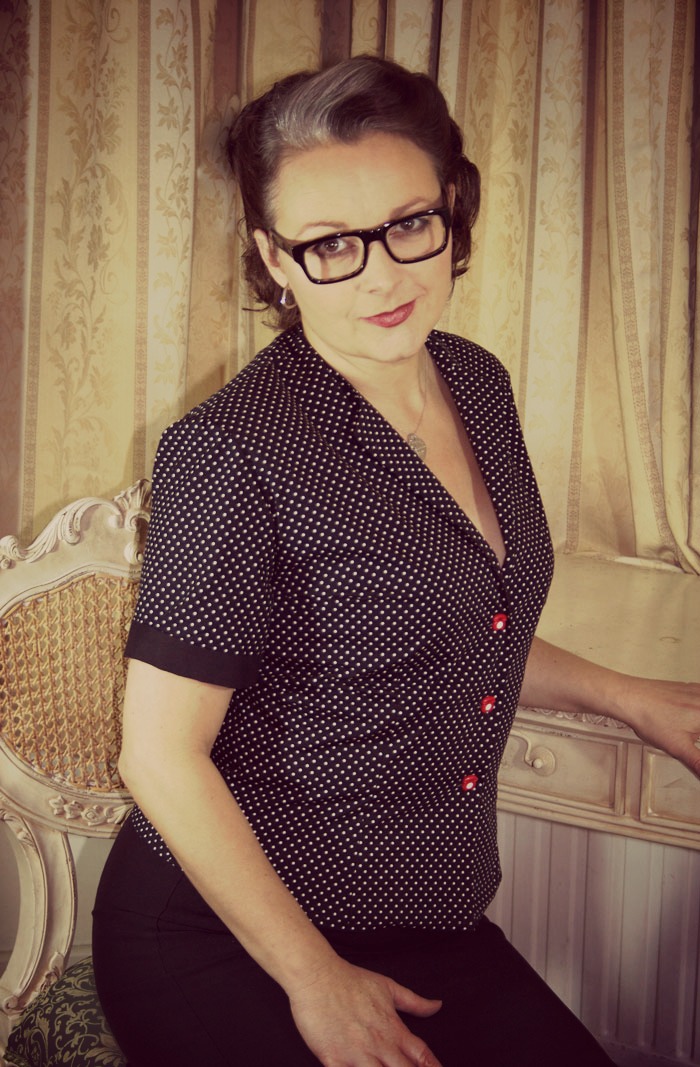
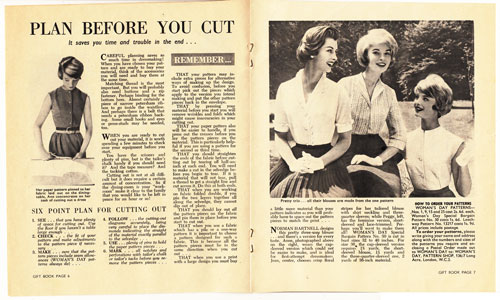
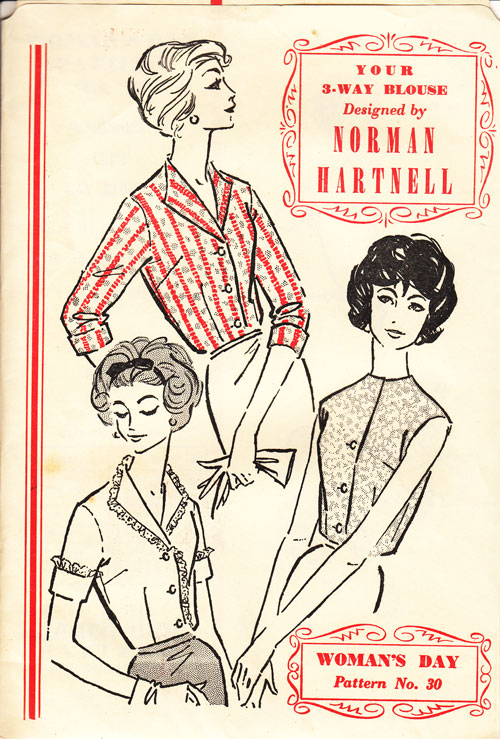
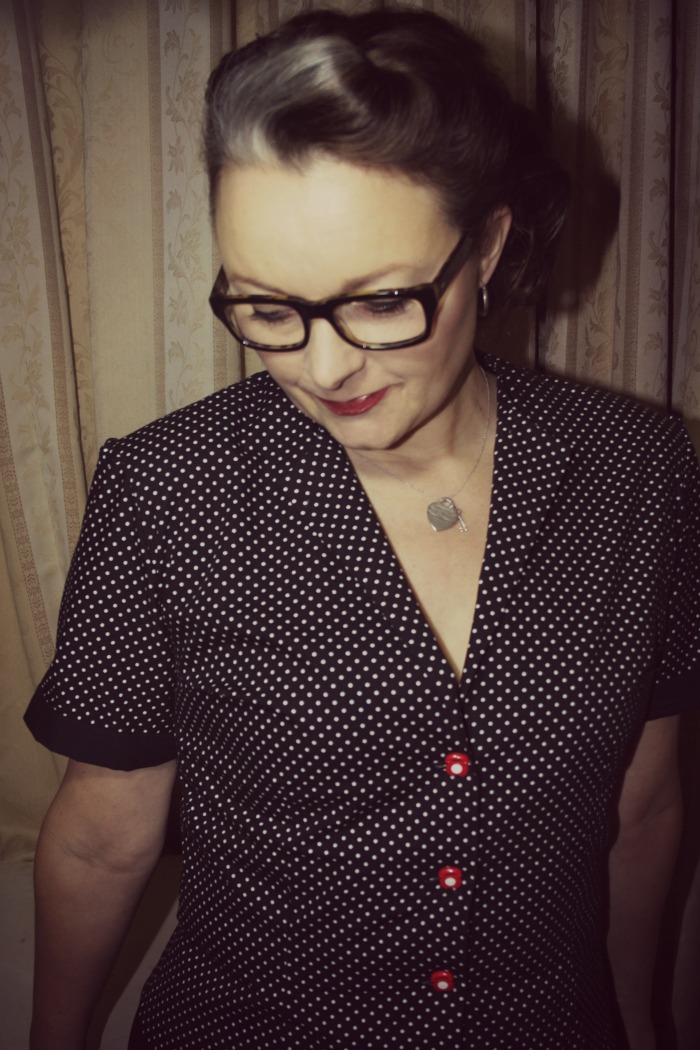
I love a 50s style blouse and this pattern was a definite sell the moment I saw it. The pattern itself was a freebie with Woman’s Day (about 55 years ago!) and as luck would have it, the gift supplement was in that Morrisons bag too. Great to see the blouses modelled and photographed. Sometimes those illustrations on the cover of the envelope give a slightly different impression to what they look like in real life! 😉
Norman Hartnell, or “Sir Norman Bishop Hartnell, KCVO (12 June 1901, London – 8 June 1979, Windsor) was a British fashion designer. Royal Warrant as Dressmaker to HM The Queen 1940, subsequently Royal Warrant as Dressmaker to HM Queen Elizabeth The Queen Mother. Royal Warrant as Dressmaker to Queen Elizabeth II 1957.”
“Although worried that at 46 he was too old for the job, he was commanded by the Queen to create the wedding dress of Princess Elizabeth in 1947 for her marriage to Prince Philip (later the Duke of Edinburgh).[1] With a fashionable sweetheart neckline and a softly folding full skirt it was embroidered with some 10,000 seed-pearls and thousands of white beads. He subsequently became one of the Princesses main designers[2] and so gained a new worldwide younger generation of clients, as the Princess began to take on more duties and visits abroad. The younger Princess Margaret became the obsession of the press and her Hartnell clothes were similarly given huge publicity and received much newsreel coverage.”
It’s a worry that he thought he was too old to continue at 46!!!
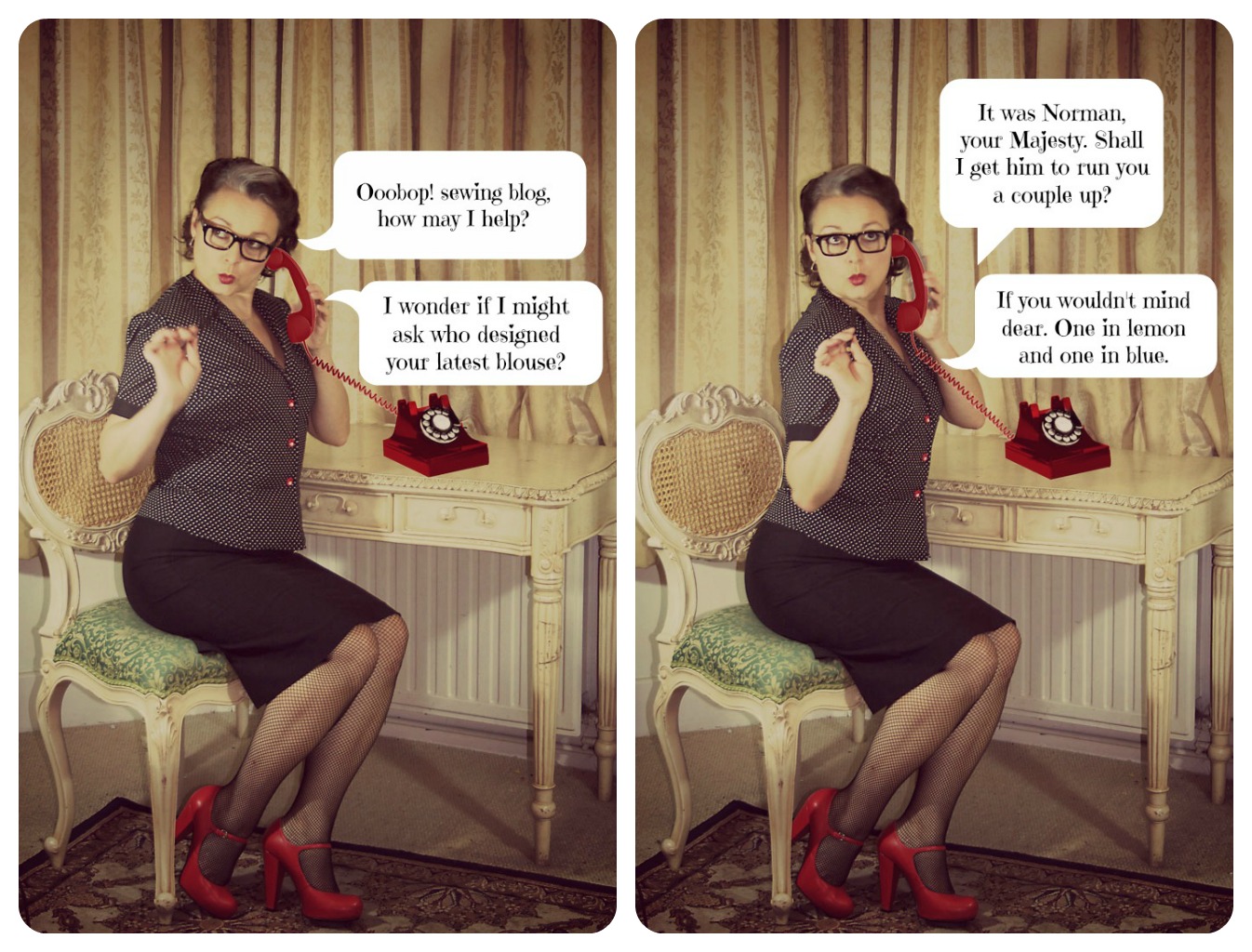
Anyhows, I quite fancy ‘a wardrobe of crisp gay blouses’. And if Norman’s are good enough for Queenie, they are good enough for me!
This was on the whole a very simple pattern. I measured off the tissue and figured I could add a bit on the waistline, as I usually do to get a reasonable fit. I made it up in a cotton poly that was semi decent just in case it worked!
But oh no! My measuring skills were unbelievably inaccurate. Either that or I have this illusion that I am the size of a small child!
I considered moving on to another project. But of course that would have been hugely defeatist of me and heaven knows I need to learn to grade a bodice properly so I set about cutting and slashing.
It worked, kind of. Well at least it fits but there are a couple of issues for a blouse so simple.
I think I need to open up on the lines of the hip a bit more. It’s a little snug!
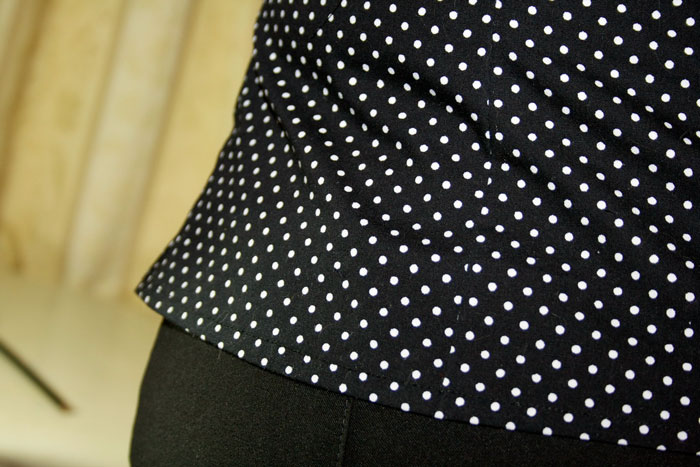
I graded up the sleeve in line with what I had increased on the bodice but there was far too much ease. So I used the original sleeve piece. Still a little too much ease for my liking but that seemed to be solved with the addition of some shoulder pads. I used the cuffs from the toile for my real one because the dots ran into each other and defeated the object of having cuffs at all!
I have to say, the method suggested for the sleeve cuffs was a bit long-winded and strange. When I do it again I will be cutting on the bias, and attaching in the same way I did to my shorts.
The winged-collar effect is not a wing collar at all. It is just the effect of opening up the facings. There is no raised collar stand at the back, just a faced neckline so it is a very flat feature. Next time, I might be inclined to cut the front piece at the start of the inner facing and sew a contrasting colour piece that folds back just to accentuate the shape.
The ‘lapels’ seems substantially smaller than those photographed. Next time I might grade the front and front facing allowance a little, too.
The instructions called for a bias cut strip to finish the back neckline and join the front facings but as luck would have it, the previous owner had cut a ‘back facing’ piece from some newspaper. I checked it against the back piece to make sure it was meant for this pattern. I just had to decrease the depth a bit, otherwise it fitted perfectly. It created a continuous facing too, which is surely a better idea and certainly much neater too. I understitched the adjoining seam, to the point just before it folds back and catch-stitched to the shoulder seams to stop it poking up, willy nilly!
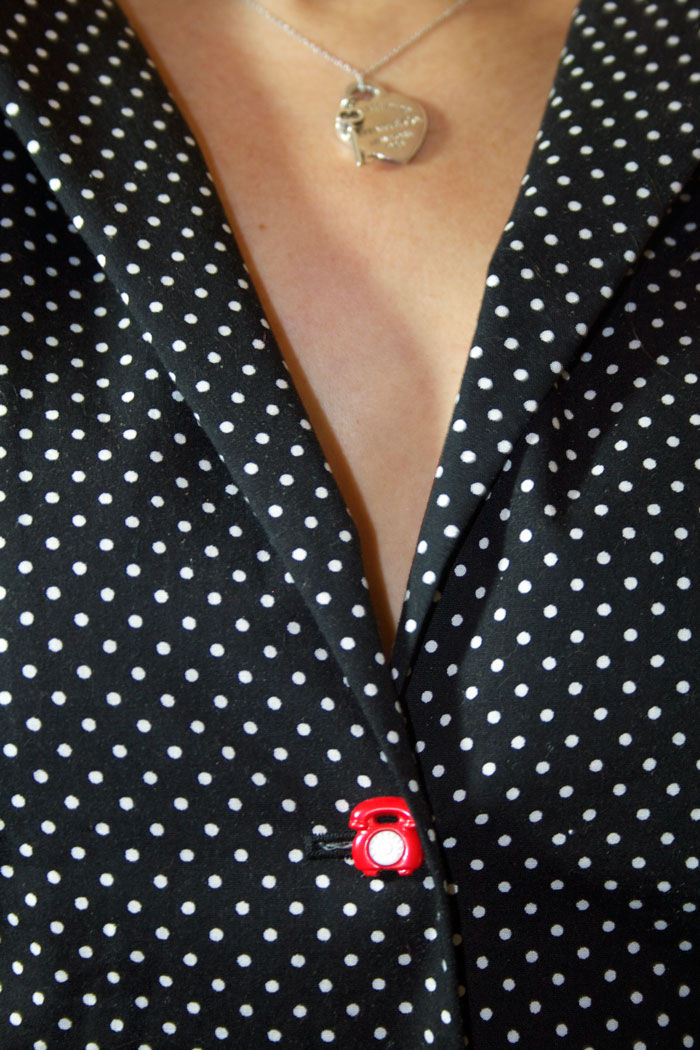
Because the design called for 3 buttons I had an array of odd interesting ones to choose from. My son so kindly remarked that, because the shirt ‘kind of looks quite old, it would be good to use those old fashioned phone buttons’. I am sure he meant that in a good way! 😉
So that just about wrapped up my chilly childless Saturday. Amazing what you can achieve in a few hours when the house is vacated. The photographs (care of the wonderful Mr Ooobop!) and the blogging took a little longer… such fun!
I had the perfect sewing window today – Little Miss O at a party for 4 whole hours and a day far too chilly to hang outside for my liking!
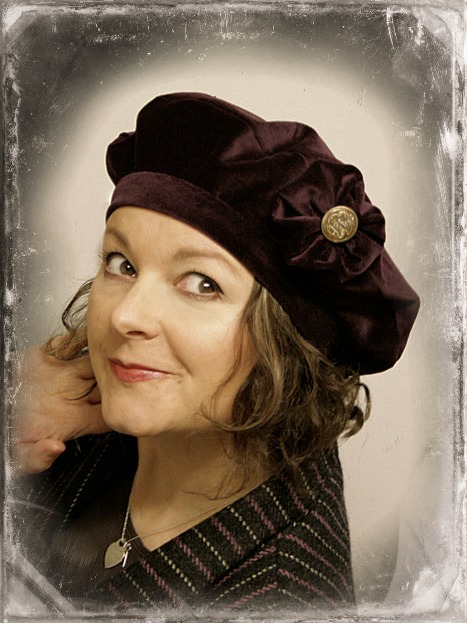
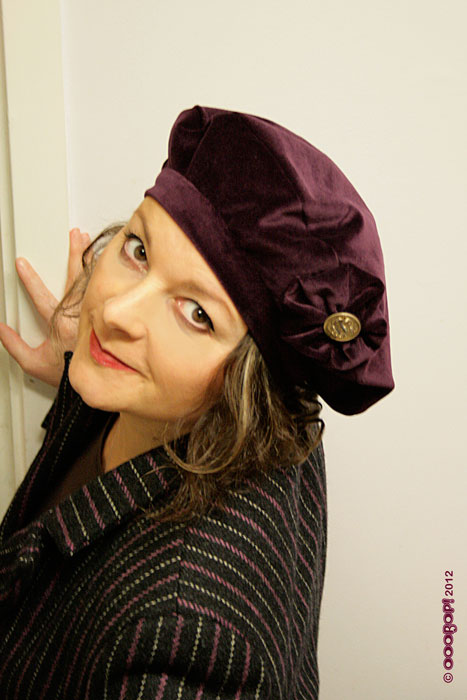
But I wont dis the weather – that would be far too predictable for a Londoner – I will embrace it. And so I hatched a plan to make a hat. I really don’t know how I get through every winter, convinced I don’t suit a hat, and freezing my poor little pixie ears off for the sake of not looking like (more of) an idiot!
So spurred on by the prospect of a toasty bonce coupled with an opportunity to make a minor stash bust but best of all, make a perfect showcase for one of my favourite buttons, the mini mission began!
Mr O had a similar hat – albeit a bit more manly! – so I set about drafting a pattern. I have quite a big head so this was another good reason to make one. If ever I find a hight street hat that I vaguely like, the chances are it will be too small!
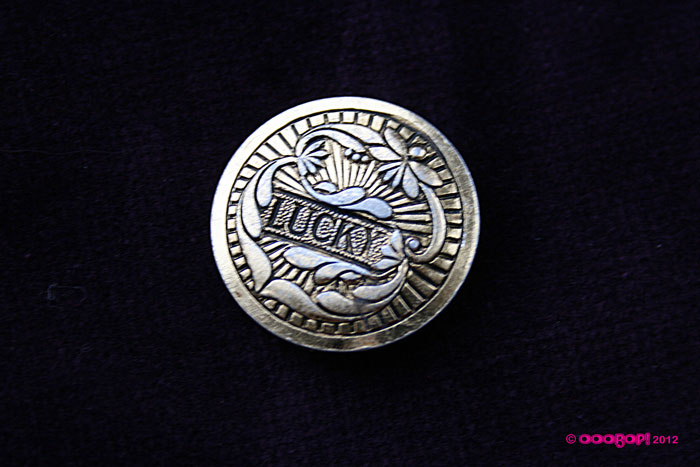
Little Miss O found this button in a biscuit tin at a vintage fair in Islington last year. Just a single lonesome button with the word ‘Lucky’ on it. Could sure do with some of that ‘luck’ stuff right now so here’s hoping!
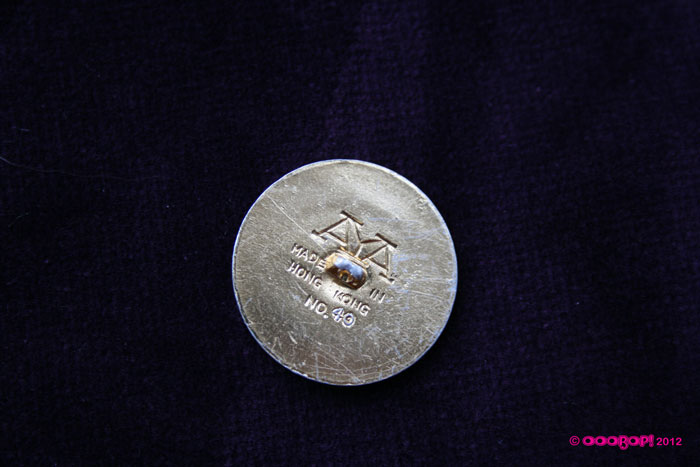
It’s got an interesting stamp on the back but I can’t find any reference on line from where it might have come from.
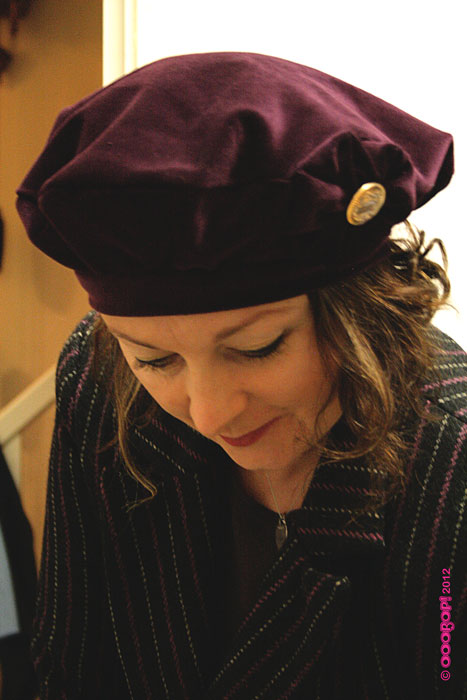
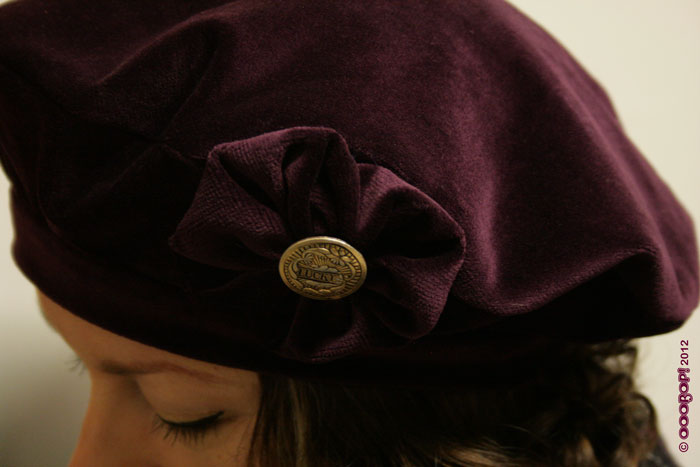
To create the decoration, I made a ‘yoyo’, my first one in fact! For those that don’t know, a yoyo is a circle of fabric (in this case the circle that was cut out for my head hole!) gathered close to the outer edge and pulled tight. The raw edges are tucked inside and some reinforcement stitched sewn. Of course a statement button is a brilliant idea to cover up the scruffy bit in the middle. Velvet is not as manageable as cotton but a few needle pricks later, the result was very acceptable!
I wore my new hat down to our ‘local’ for dinner tonight but didn’t take it off. I was a bit worried about the hat-hair issue. But hey, guess what happened when I took it off when I got home?! Hair looked better than it did pre-hat!
The outer fabric is a cotton velvet, wonderfully donated to me by a friend who was having a clear out. There are many more metres so I am contemplating a matching jacket! Contemplating I said!!
The inside is fully lined with a matching poly lining so it feels really neat. The band was machine stitched, right sides facing and then turned inside like giant bias trim and hand stitched to the seam line, using an uneven slip stitch. The stitches were quite small and sunk into the pile of the velvet so I am very pleased with the results.
I’m pretty sure this kind of hat will go with vintage or modern styles. Just need to make a few more in different colours!
Thanks to the wonderful Mr Ooobop! (of course) for the fabulous photos!
First I must thank you all for your lovely comments on my initial post about the finished jacket. I’m so touched and I love that warm and fuzzy feeling I get when they find their way into my mailbox!
So as promised, here is some nitty gritty detail from the project for those that might be considering this jacket for the first time.
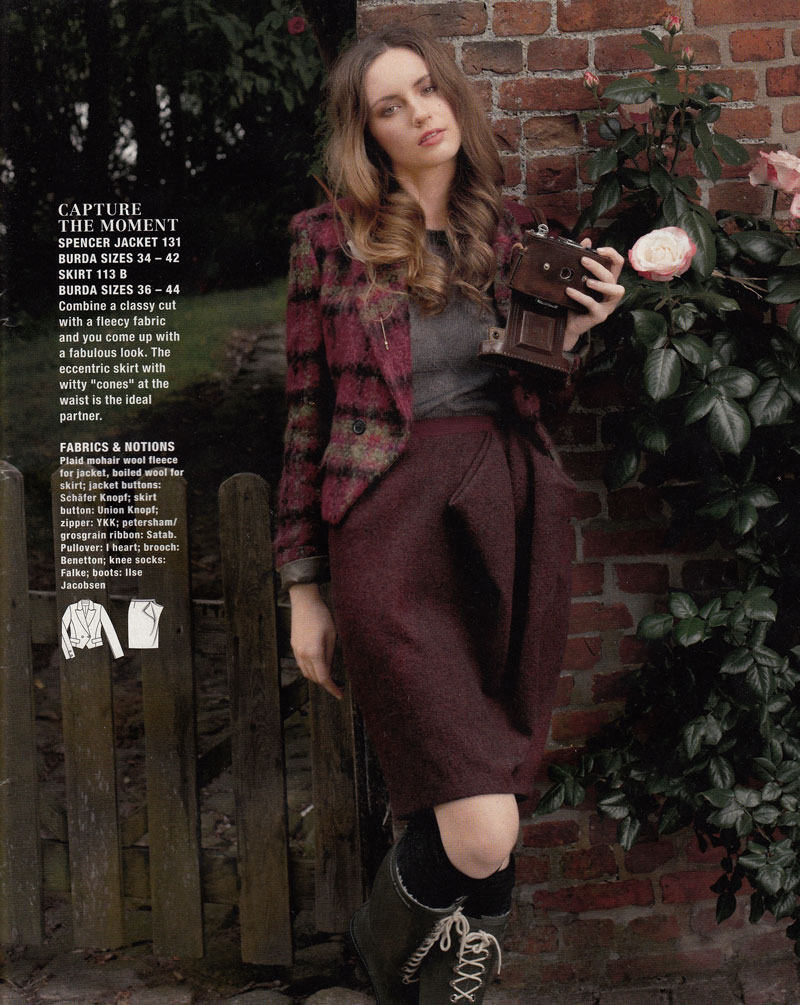
Burda jacket #131 11/2012
Though I am pleased overall, with the results. I can’t help being niggled that more tailoring techniques weren’t employed. I’ve only myself to blame. I could have researched them myself but there’s always a next time!
The jacket is cut from pieces #131, Burda Style magazine 11/2010 but the construction details are from #130. The only difference being that I chose the full length sleeves with vents… and proper working buttonholes… glutton for punishment, me!
I made the toile back in February and was intending to make adjustments to the waist only. But I got worried about it’s ‘snugness’ and just went up a size in the end. A little bit chicken perhaps, but also concerned that I was more likely to be wearing a few layers underneath in the colder months!
It is essential that you make a toile. There is so much work involved in this, you don’t want to get to the end to find it doesn’t fit!!!
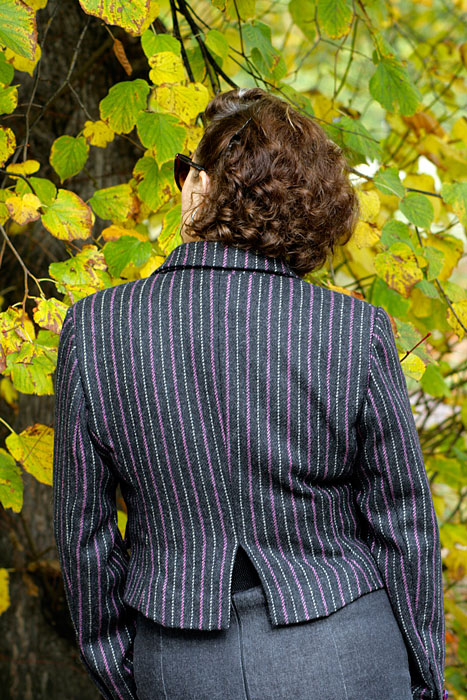
My first slip up, that I DIDN’T clock until I got round to dealing with it, was the back vent. I am so used to adding the statutory 15mm seam allowance to each edge that I clean forgot to add 4cm as specified, to the vent openings. Doh. I could kick myself. It doesn’t look so bad in the photos but I know that it isn’t created properly. It is intended as a ‘split’ but would have been so much neater with an interfaced proper allowance. So please remember to do this if and when you cut yours! I would even go as far as to make it a vent rather than a split. But that opens another can of worms with the lining!
back split that really wants to be a vent!
The miniature pattern layouts indicate what pieces are to be interfaced with fusible interfacing. I did toy with the idea of sewing traditional interfacing. I liked the idea of employing some traditional skills but I agreed with myself that I was embarking on a big enough journey and that the fusible stuff would be just as good for what I was trying to achieve.
And so the interfaced pieces included: centre front; side front; outer collar stand; under collar; back facing; outer pocket flap; neck and armhole edge of centre back.
The main construction of the body came together very easily. Darts seams and pressing.
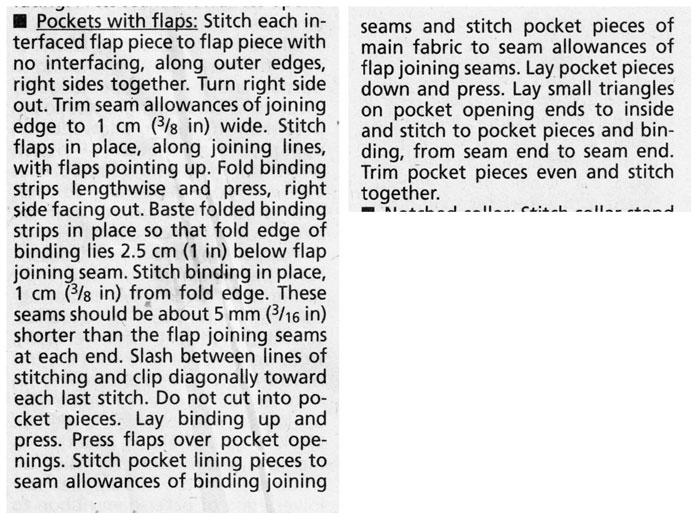
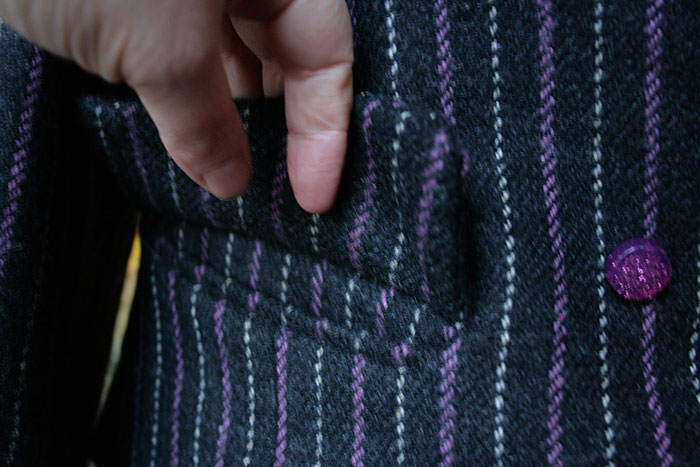
But then came my reality check. Welt pockets with flaps. Needless to say I practiced these before the real thing. You can see how I got on with this here. Well worth checking out YouTube or the Burda site for instructions. I challenge anyone to get the gist of welt pockets from the following instructions!! Or it could be just me!!
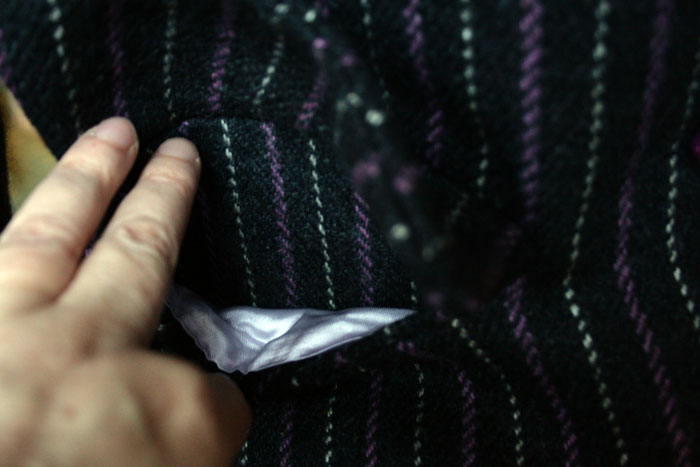
I am over the moon at how they turned out in the finished fabric. I don’t intend to put anything in the pockets, for goodness sakes, don’t want to misshapen them! But I am so proud when I slip my hand inside. Feels so special! And no one gets to see that lovely welt under the flap, except moi! Though I have pointed it out to a few of my friends who smile loyally with raised eyebrows!
welt pocketpeek at the pocket lining
Next up was the notched collar. This was actually not as scary as I was anticipating. I did pin and I did baste before stitching and it all worked out just fine. The stitches sank invisibly into the wool when I machined the seam so I didn’t want to risk having to unpick at any point! Neat trimming and clipping is essential and it is also important to take care when you ‘push out your points’ Very easy to push a pointed implement through the point of the lapel, (especially if you are using soft wool) and ruin everything. It’s worth being slow and patient with this part because it is such a lovely sharp feature. You’ll be really chuffed when it comes together at this point.
pointy lapel and notched collar
There was a suggestion to sew the pointed lapels to the underside of the collar to keep them in place but I didn’t really feel this was necessary for the weight of the fabric I used. I like being able to turn up the collar when its chilly!
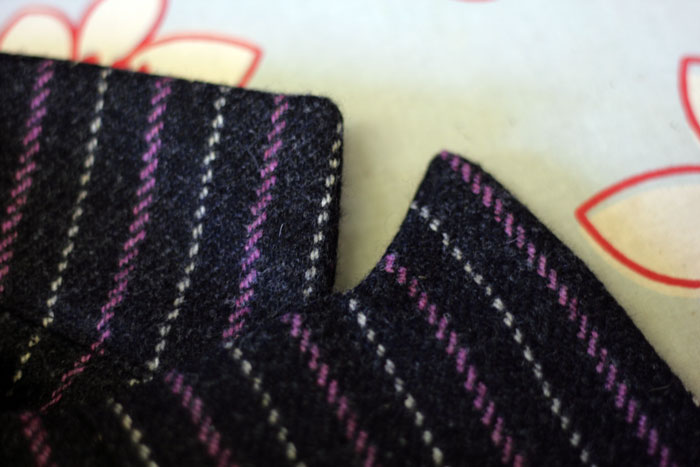
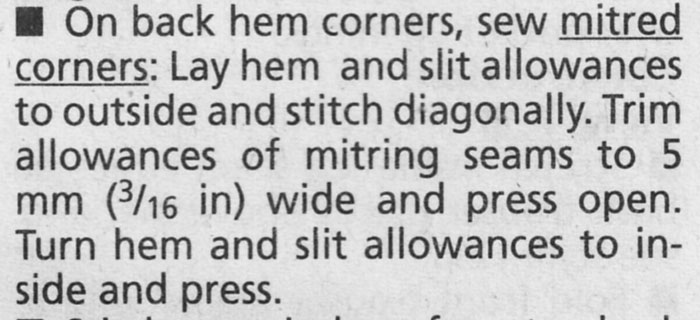
Now shall we talk mitred corners? I’m so glad these were included. It makes so much sense and makes such neat corners. Nothing else will ever do from now on! Of course it goes without saying that you won’t survive with these instructions, especially if this is your first time…!
I mitred the sleeve vents and the back vent in the same way. Though I had created a bit of a monster on the back vent by forgetting the extra allowance. Please don’t forget this!!!
not enough SA on the vent but check out those mitred corners baby!
When I came to set in the sleeves I realised I had clean forgot a couple of notches. You will never work out how to inset those sleeves if you forget the notches, I can tell you. Mostly because I tried… and failed… 3 times!!! Till I relented and placed the pattern pieces over the made up sleeves and marked them.
Once I’d put the shoulder pads in, I tried it on and grinned from ear to ear. I was definitely on the home straight! But one niggling factor was that I didn’t like how the sleeve just ‘hung limp’ off the shoulder. I had heard mention of sleeve headings before but obviously never had to take full notice. So I found this little tute in my book Readers Digest: New Complete Guide to Sewing. This book has been so useful and really didn’t let me down this time.
Make a sleeve heading:
Cut 2 pieces of 3 x 5 in (7.3 x 12.5 cm) pieces of lamb’s wool, flannel, or polyester fleece. I had some leftover cotton flannel from my son’s pyjamas. Probably not as weighty or as poofy as lamb’s wool but it was better than nothing!
sleeve cap pieces
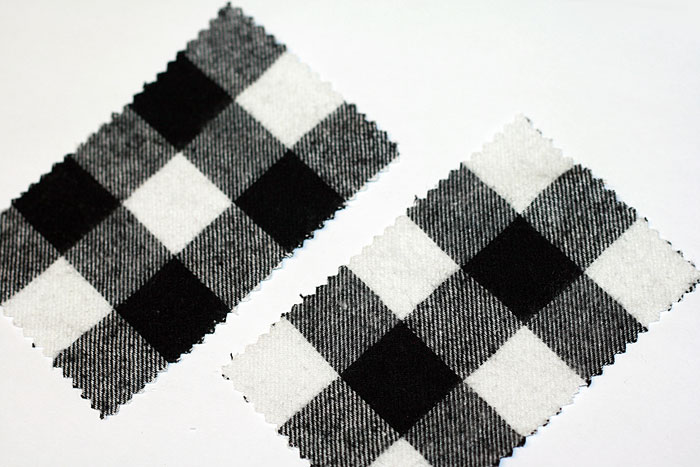
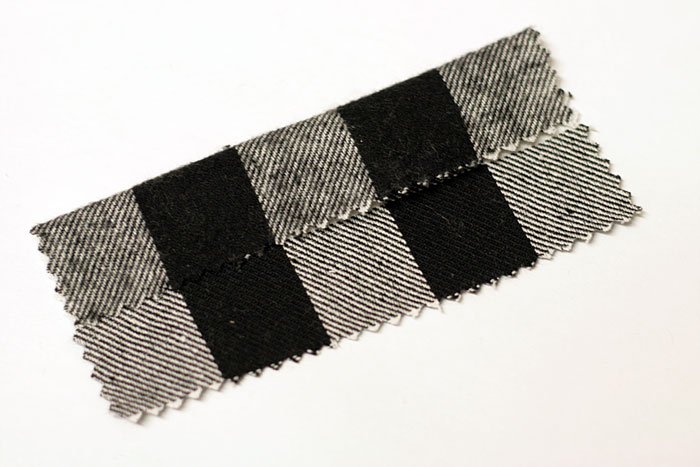
Make a 1 in (2.5 cm) fold on long side of each piece. How lucky is this. My fabric had 1 in square pattern!
sleeve cap fold
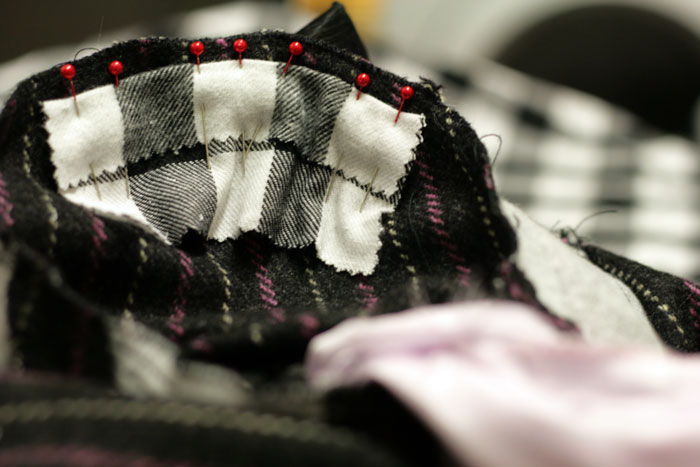
Centre and pin heading to wrong side of sleeve cap with fold against seamline, wider half of heading against sleeve.
sleeve cap pinned in position
Whipstitch fold of sleeve heading to sleeve seamline. Heading now supports and rounds out sleeve cap.
without sleeve cap
The difference is subtle but is hugely important for my self satisfaction!
with sleeve cap
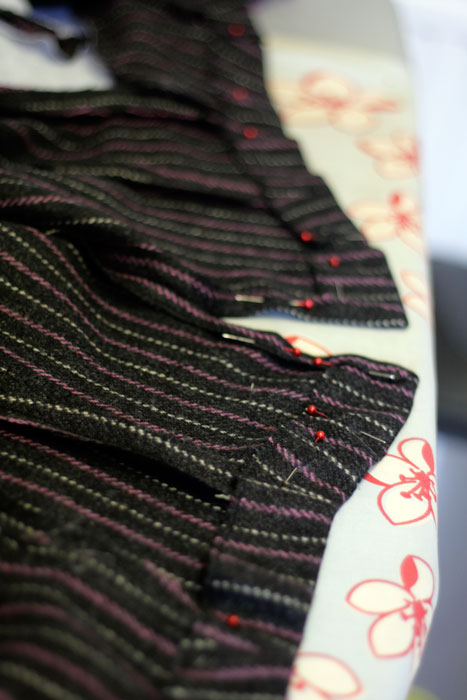
Before I lined the jacket I neatened and pressed all the seams. I did wonder if you have to neaten the raw edges, after all they wont show but I was worried about it fraying inside with wear and if it might eventually have a knock on effect to the seams coming apart. Probably over worrying but better to be safe than sorry was my own conclusion. But here presented my next concern. As much as I pressed this gorgeous wool, the seams would not lie perfectly flat throughout and I knew that would affect the overall shape and create a lumpy lining. And who would want lumpy lining?!
So I decided to stitch the seams down, like a good tailor lady. But hey! Guess what little tailoring trick was missing. NO UNDERLINING!!! Not that I have ever had to underline anything to date. But I have heard about it. I have wondered why you would want to but now it was blindingly obvious. My fabric was sturdy enough to live without it but how much easier would it have been to sew the seams down flat onto an underlining. I will definitely underline next time I make a jacket and I wholly advise you to do this even if you think your fabric is sturdy enough. It makes sense you know!! Fortunately my fabric was quite thick with a forgiving texture!
stitching seams down sans underlining
I found it was much easier to do, over my knee, whilst watching The Paradise! And also safer to stitch onto the interfaced pieces.
stitching seams down on interfaced sections
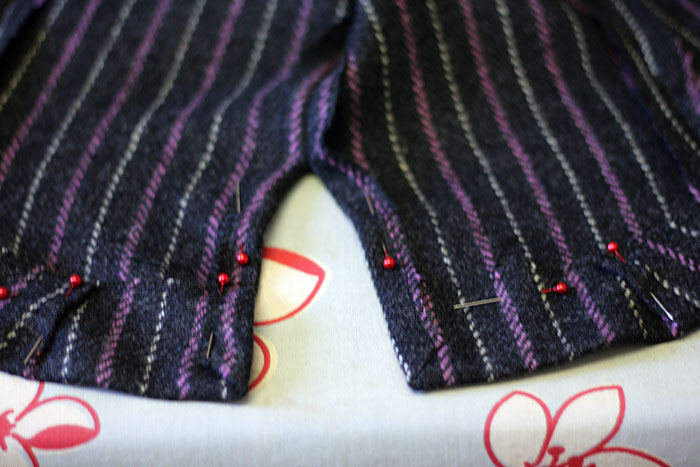
Hemming was easy with this fabric but be aware that a curvy hemline is naturally created with all those shaped pieces. To take in that excess fabric I just made a couple of tucks either side of the vent, symetrically positioned so that the finished shape was uniform. You’ll notice here that there is no evidence of interfacing. After I hemmed I remembered I was supposed to interface the hems. So I dutifully unpicked all that hand stitching, cut some strips of fusible interfacing, fused it on and re-hemmed. BUT do remember to interface the hem sections of your pieces from the start and NOT at this stage. You know it makes sense 😉
wavy hemline
So then came the lining. I had pondered a silk lining but the lilac poly satin I found was so lush I looked no further. So long as you remember your ‘ease pleat’ in the centre back, you can’t go far wrong. I can’t give to much advice about this stage because I kind of winged it!!! But what I did remember to do was to push the lining up to the hemline of the outer fabric and roll it down over itself to create more ease and allow for shrinkage. Not that poly lining shrinks but I think its general practice! I did the same on the sleeves. I’m not sure I lined the vents on the sleeves properly but it works… of a fashion!
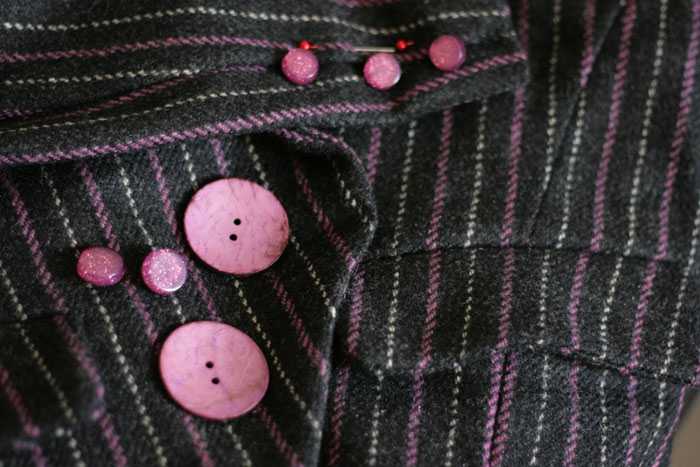
The buttons were a lucky find, though I was gutted I couldn’t find smaller coconut shell buttons. The two pictured here were way to big even for the front! So sparkly resin shank buttons it was. Lucky to find them in 2 different sizes at Shepherds Bush market. 20p each… a snip!
I WILL find a perfect use for those coconut shell buttons!
I created the buttonholes on the machine. Holding my breath as I did so. You know how it is. There’s always a chance of a wayward buttonhole! But next time I would love to try bound buttonholes. Karen did such a beautiful job with hers and I bet it feels far more special to button up with bound ones!
Well here ends my waffly post of niggles. I hope to have been of some help and not too much of a waffling bore!
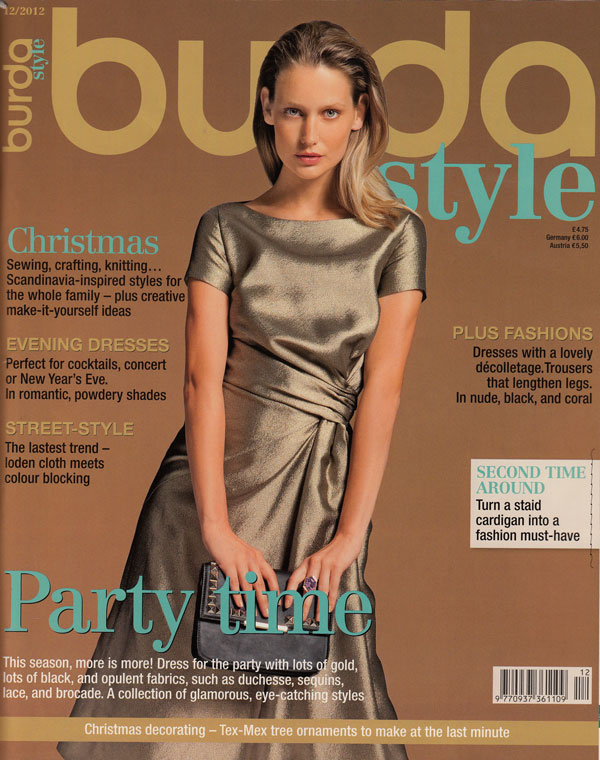
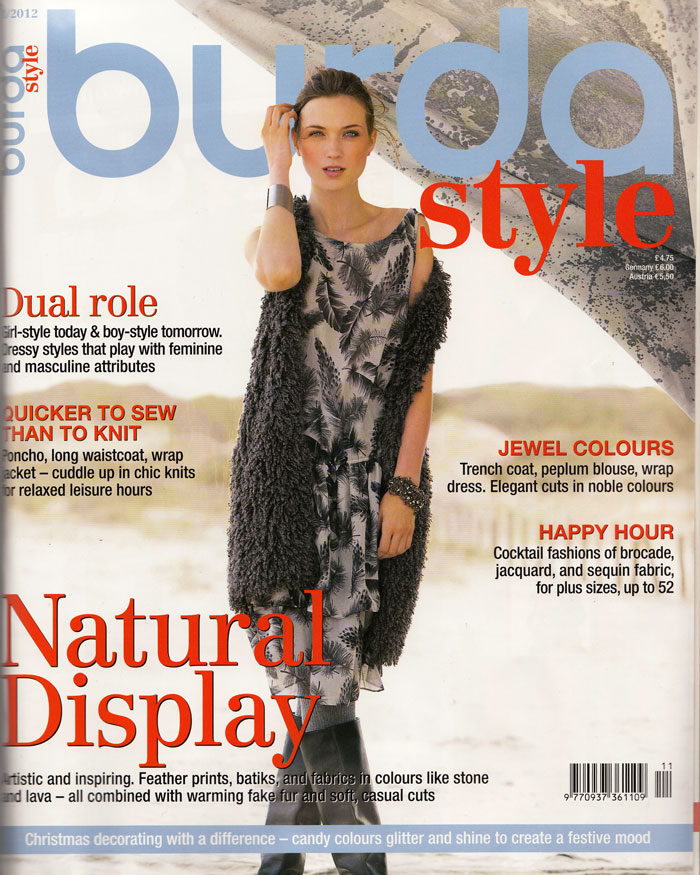
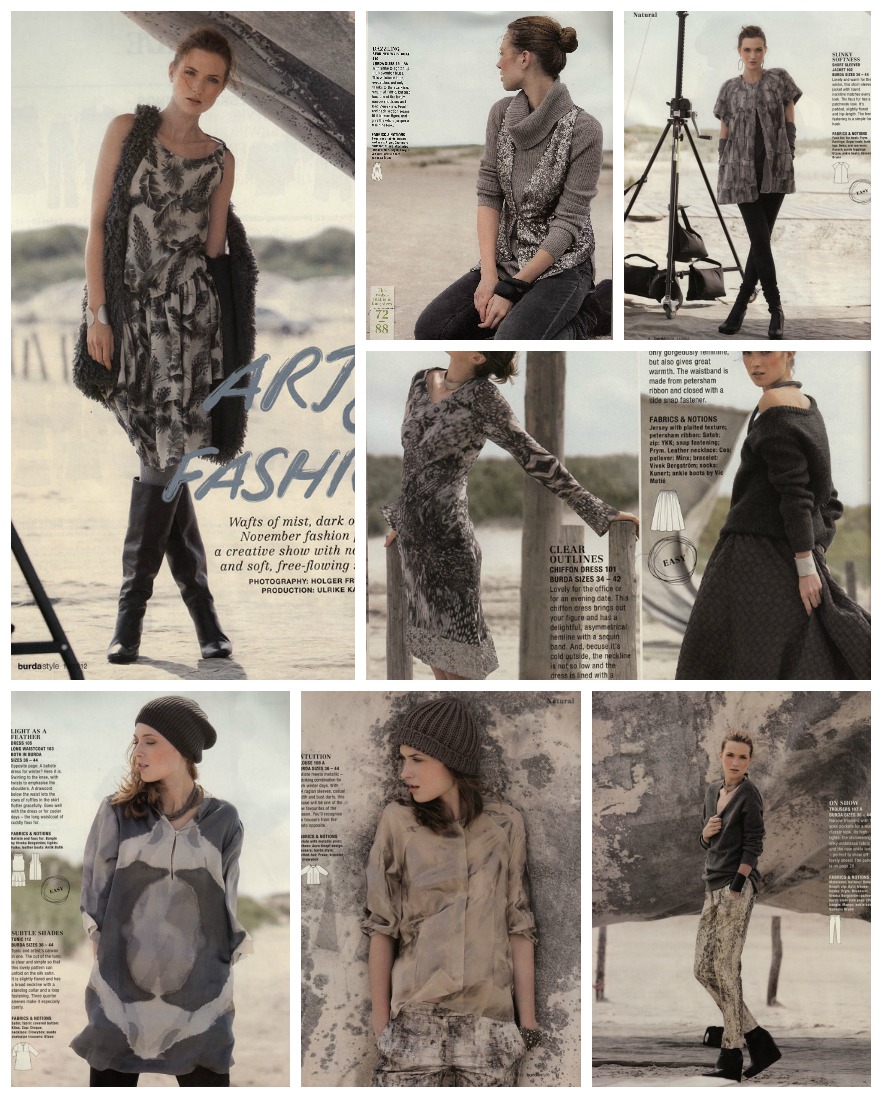
A little later than usual but I do hope that November 2012’s Burda Style magazine serves to whet your appetite and make your sewing list longer all the same!
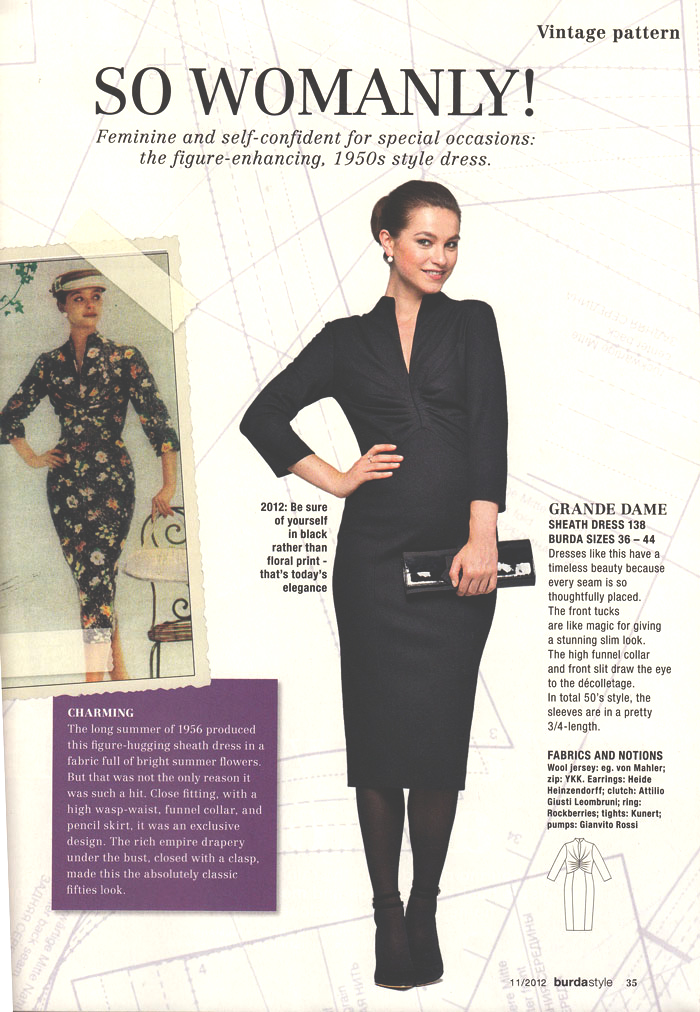
I’m going to jump straight to the Vintage pattern because that is exactly what I did in the shop and it is so totally my favourite and my best! I do like it in black but I also like its original floral form. Such style in the fifties! Bring it back, I say!
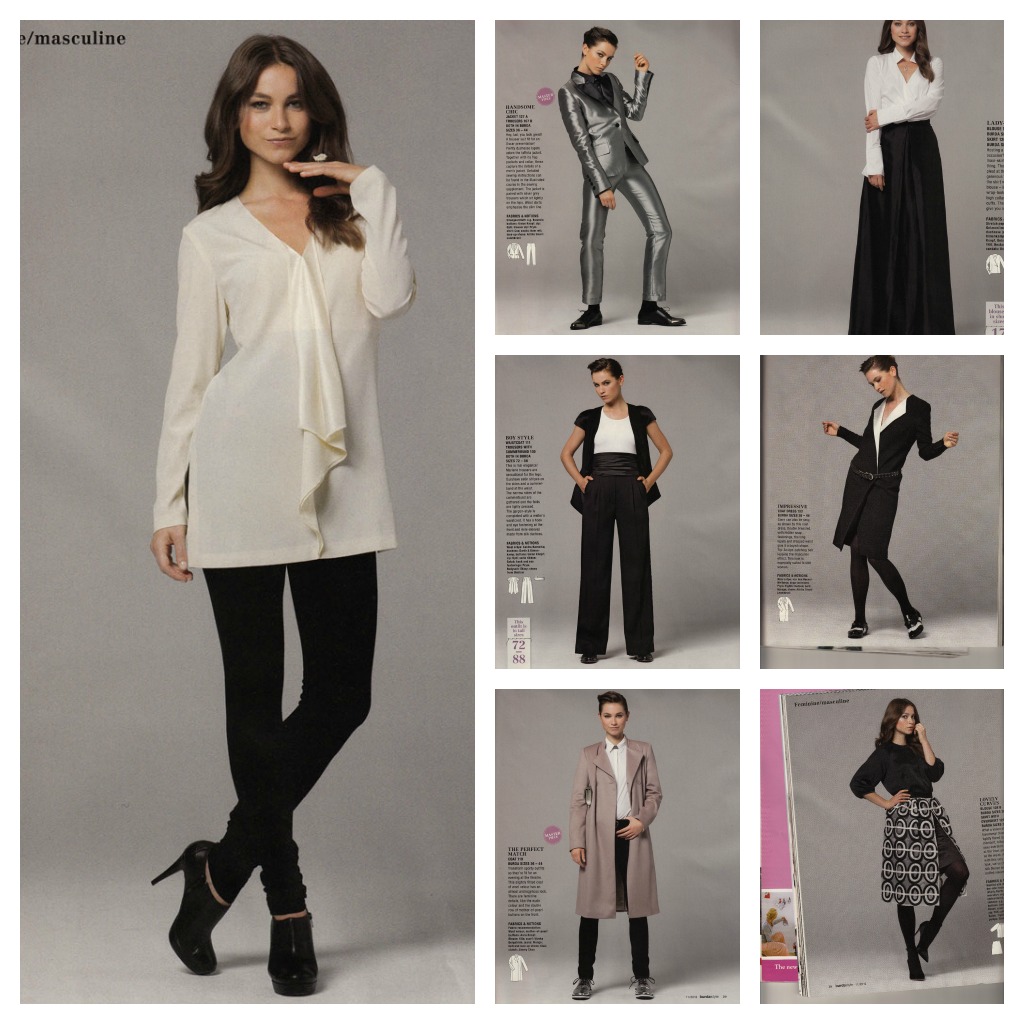
Lots of lovely misty neutrals in the first section this month. I am quite surprised to see a floaty batiste dress (top left, below) considering the chill factor but I like it all the same, especially styled with boots and the faux fur waistcoat. I am also tempted by the blouse, centre bottom row. Batiste with a metallic print…. not sure I will stumble across that fabric choice in the Goldhawk Road, but always worth an ask! It’s got 3/4 raglan sleeves and bust darts so its simple but not completely shapeless.
The trousers (bottom right) are nagging me to attempt my first pair of trousers. These ones have hip yoke pockets and are ankle length to display some fabulous show-off shoes!
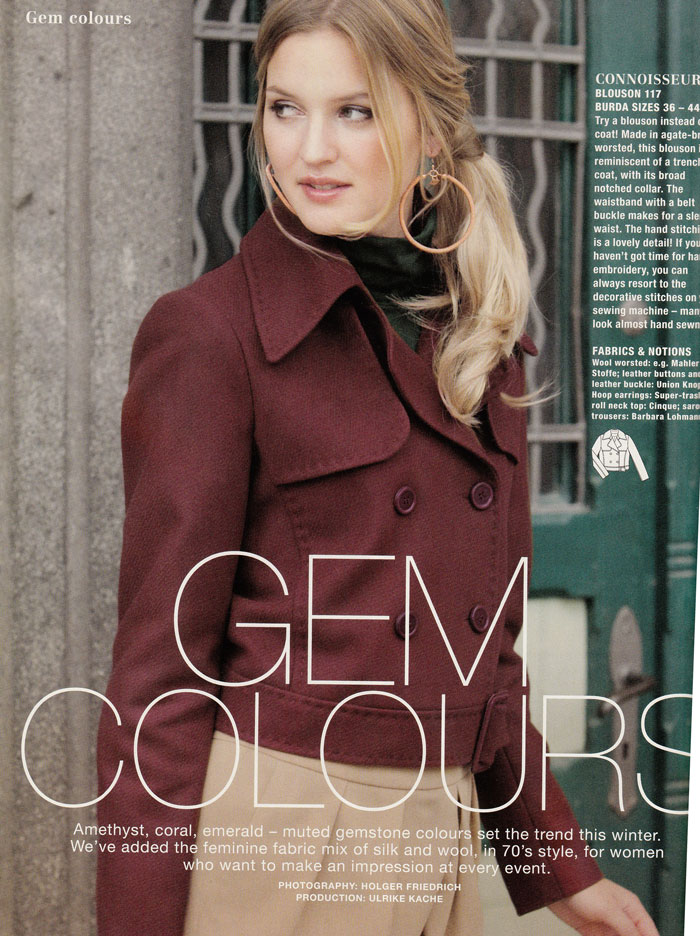
Next up is the Gem Colours section. You may have already have seen some of these patterns on the Burda web site. They were quick to go up this month.
This jacket or ‘blouson’ as its called here, would present such a rewarding project. Having just completed my first proper jacket I’m itching to employ some more tailoring techniques and this one looks like it could present a few more. Its got some beautiful hand stitching going on which gives it such a professional finish.
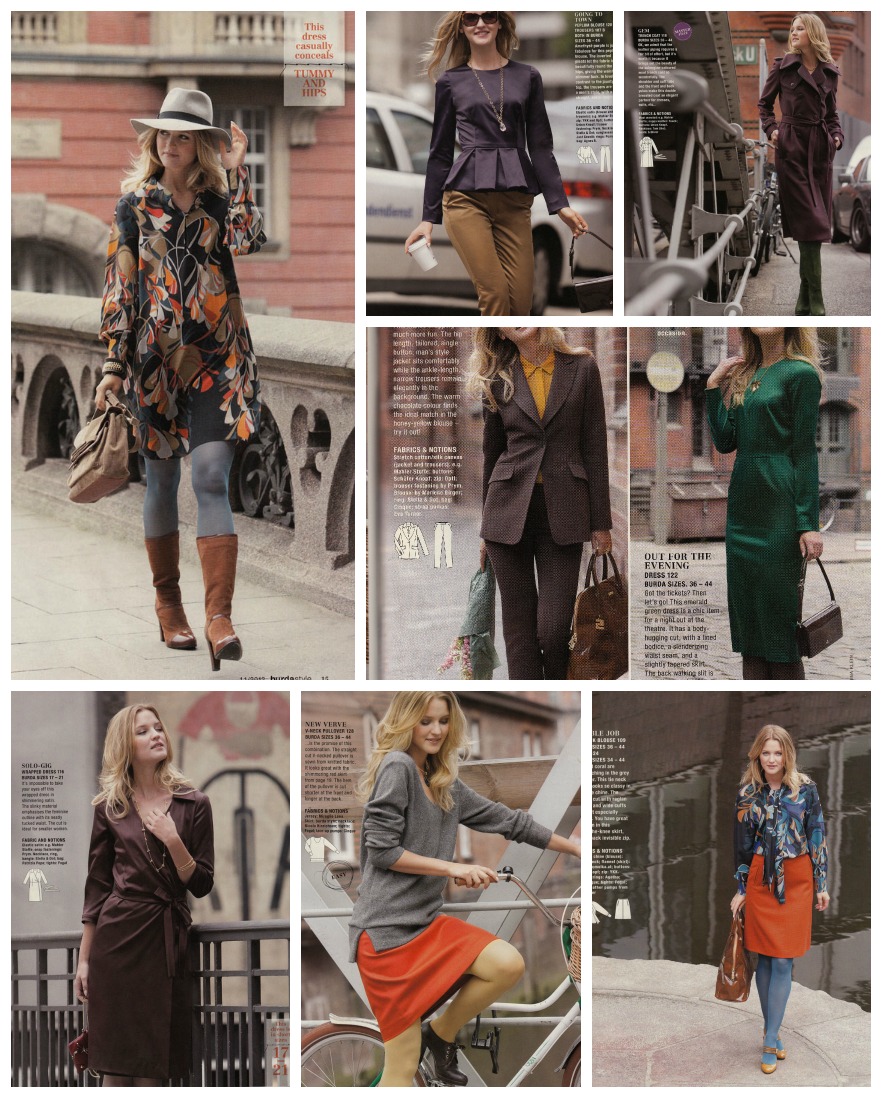
Undertones of the 70s with oranges, purples and browns are the order of the day for Gem Colours. I’ve not worked with crèpe de Chine before but I think the first dress (below, top left) would be a great place to start. It’s semi-fitted and has a wide neckline, with broad sleeves that taper into slip on cuffs. Perfect for those bloaty days or when you just want to throw something over a pair of leggings or sturdy coloured tights before flying out the door.
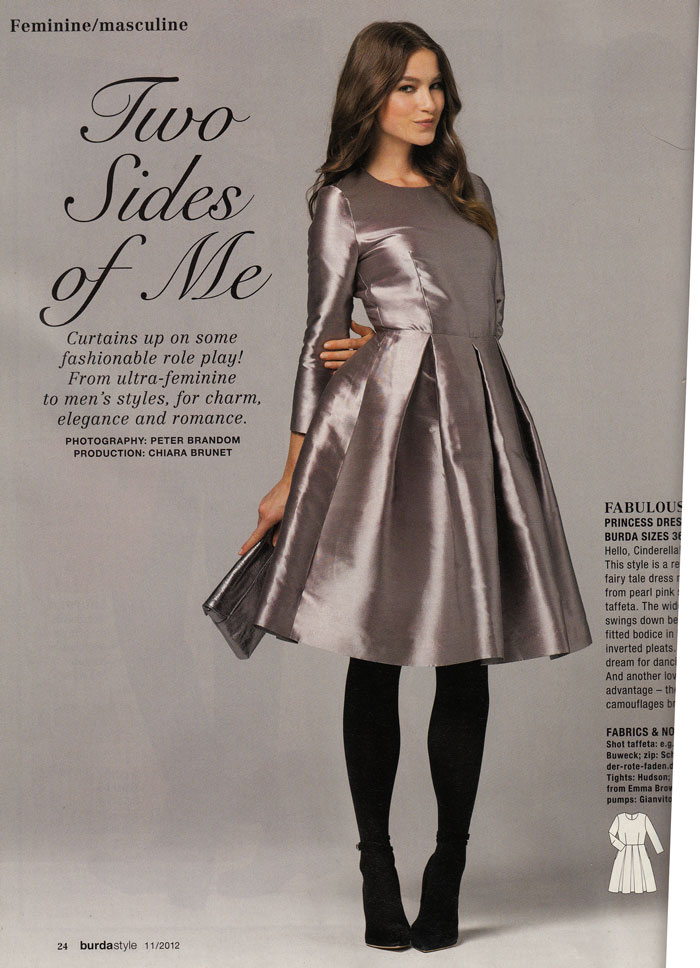
Two Sides of Me is an interesting section this month. I like the dress!
Not too sure about the boyish looks. Bit boyish for me to be honest! But I’m quite drawn to the blouse on the left. Not my usual style but I like the idea that this could be whipped up a couple of hours before a theatre date! It is made of stretch silk satin here. Much like my pin up pants, so I bet it feels gorgeous on!
I kind of flicked past the Knits section to get to the Kids. Nothing against knits, honest, and I feel bad now for not including them. But they just seemed like staple loungewear. And I need to avoid making stuff that everyone is going to think is from ‘Primani’!
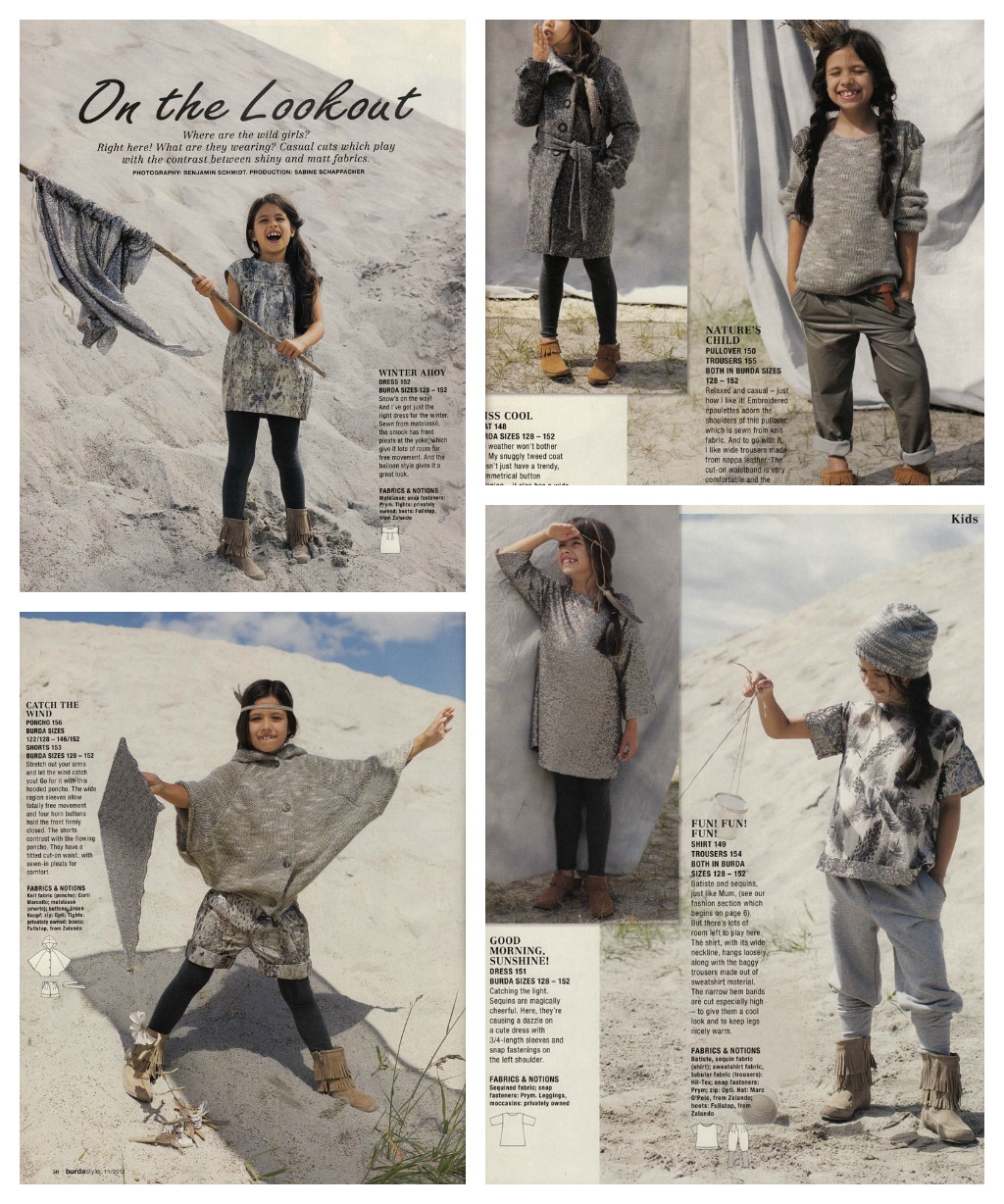
But… there is some totally cool kid stuff as usual. Keeping the neutral theme and mixing up metallics and matte. Lovely textures and fun, chic designs that will even fit Little Miss Ooobop!… hoorah!!
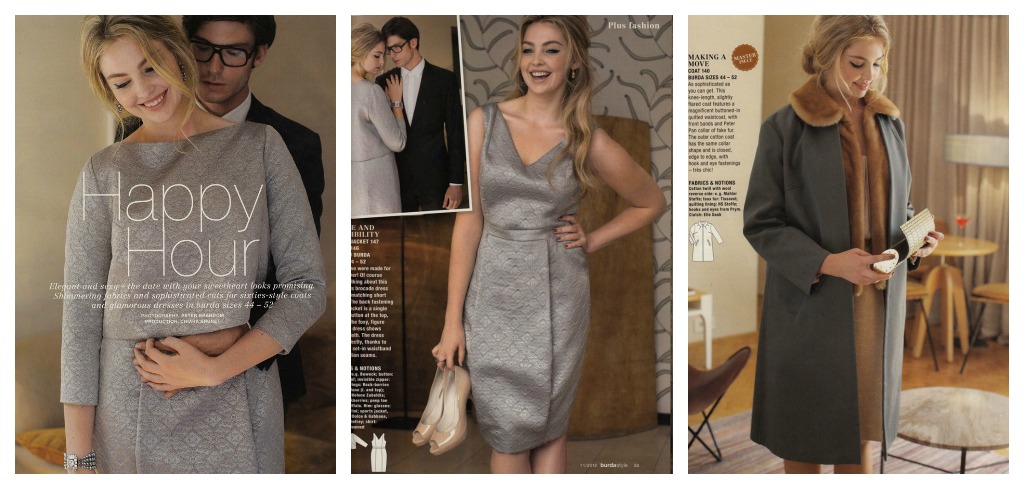
And a Burda mag would never be complete without some hot plus-size gorgeousness. My picks this month are very vintagesque. Creature of habit, moi?! Very elegant and sexy and perfect for a hot wintry date!
Any faves? Any dislikes? Feel free to share your thoughts!
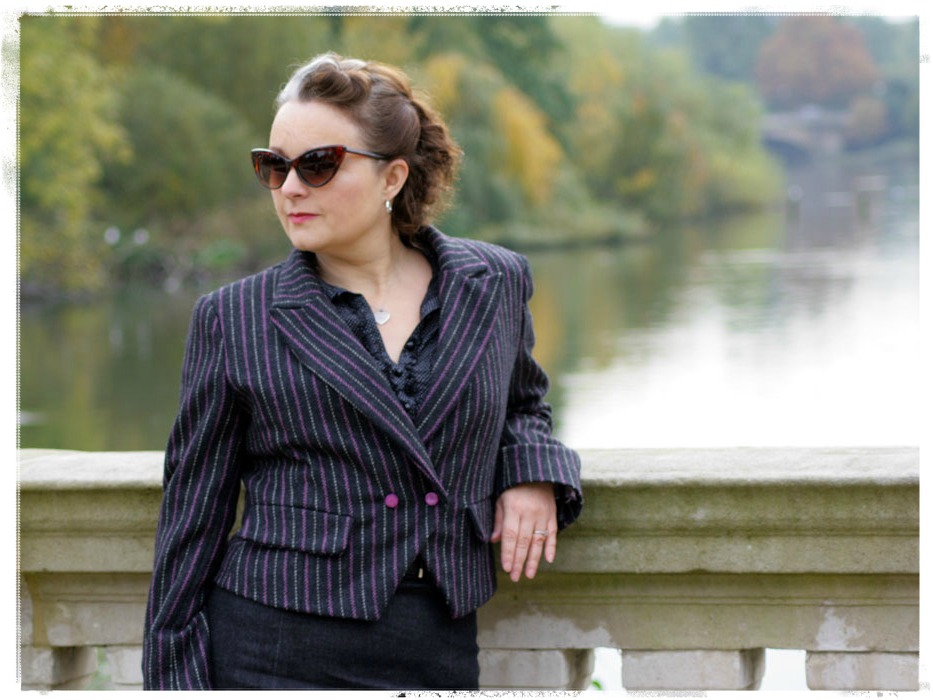
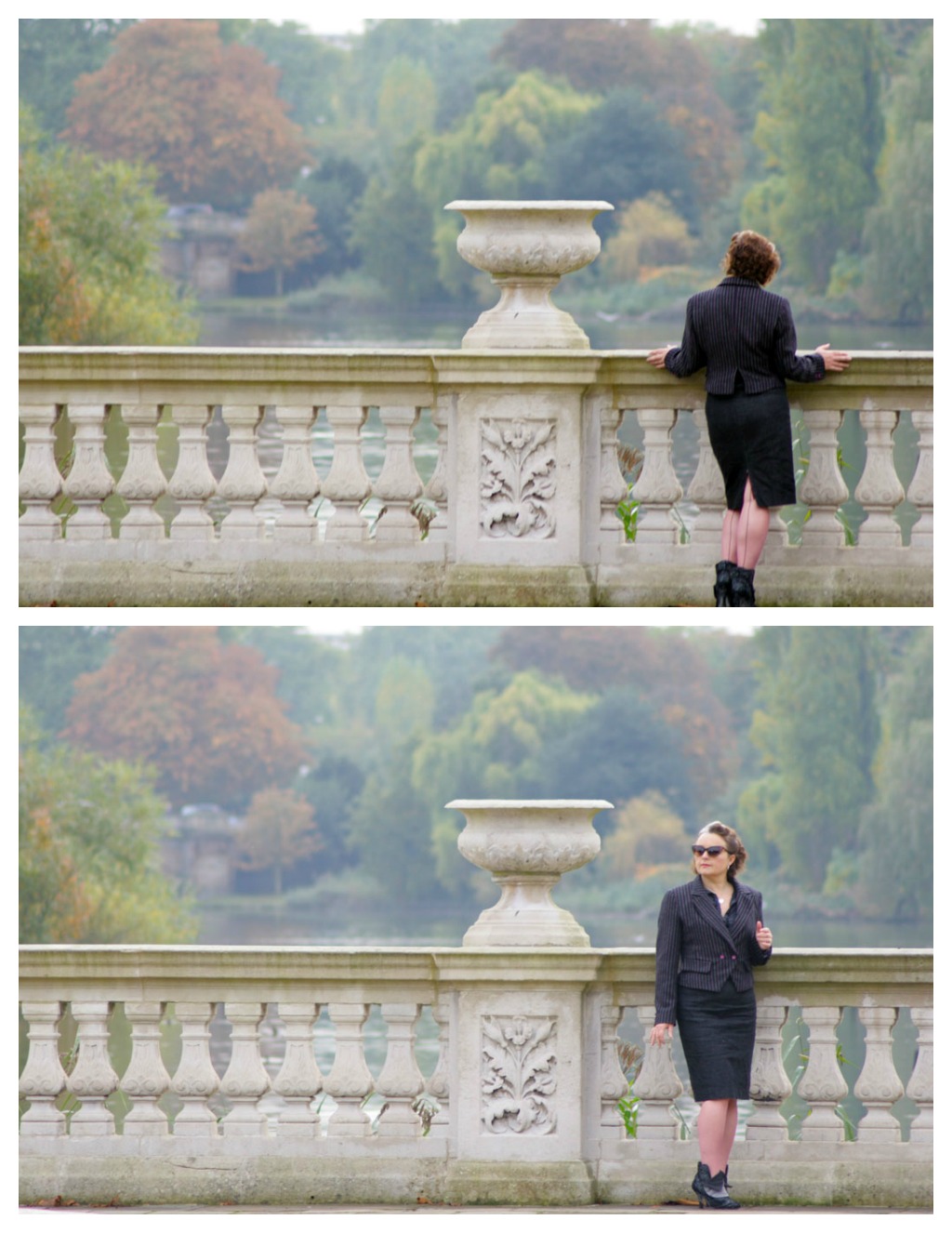
Well, from the very beginning would probably be a good idea! I started this jacket way back in February but was wearing it in my head from the first time I saw it in Burdastyle mag 11/2012! I completely ignored the number of coloured circles which indicate level of difficulty. Half a circle short of the most difficult… how difficult would that be?!
It transpires that it wasn’t particularly difficult, once I’d deciphered the 2 magazine columns of instructions, though my strops might have suggested differently. I really don’t respond well to written instructions as much as pictorial ones!
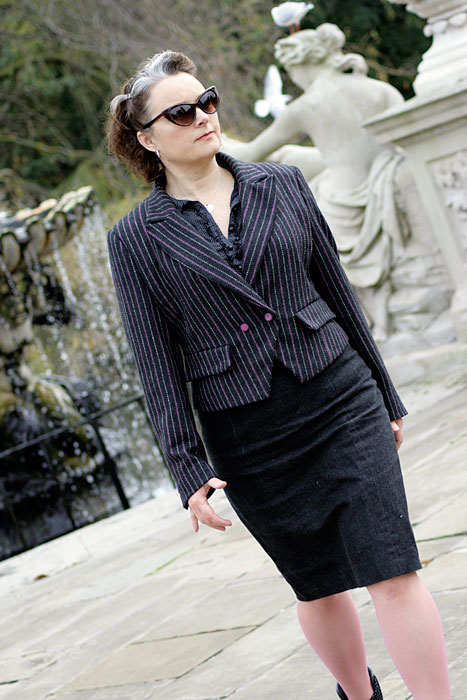
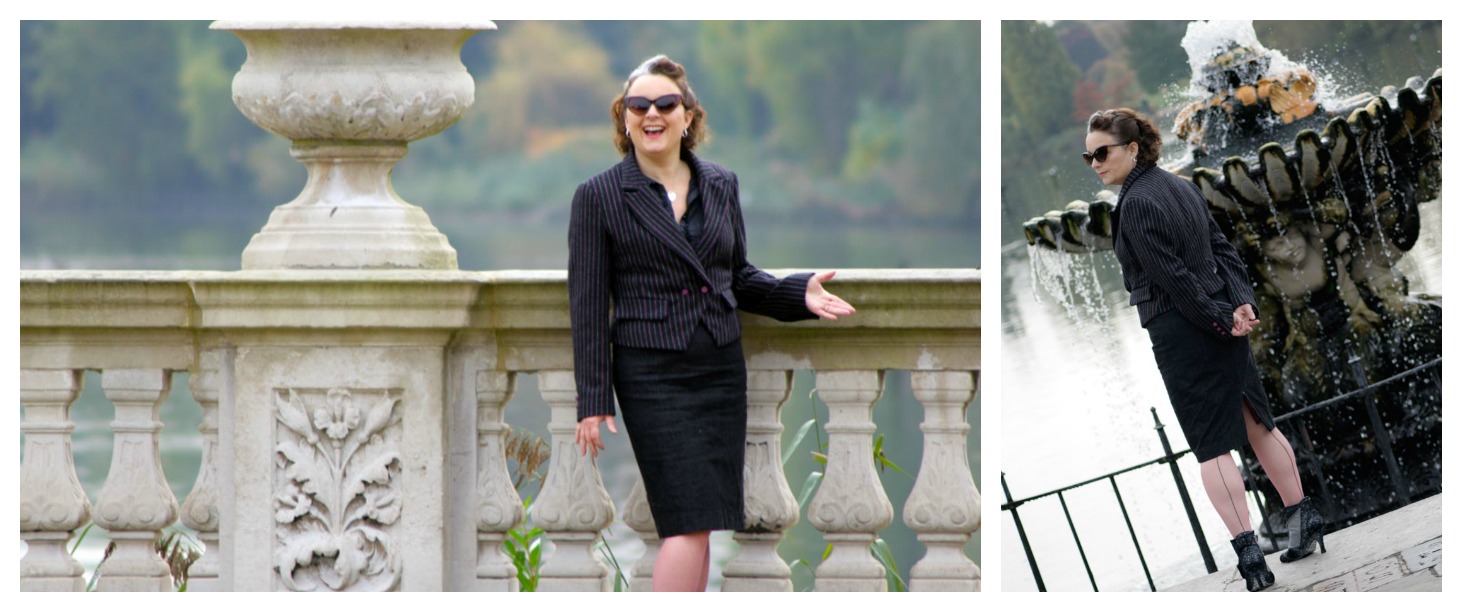
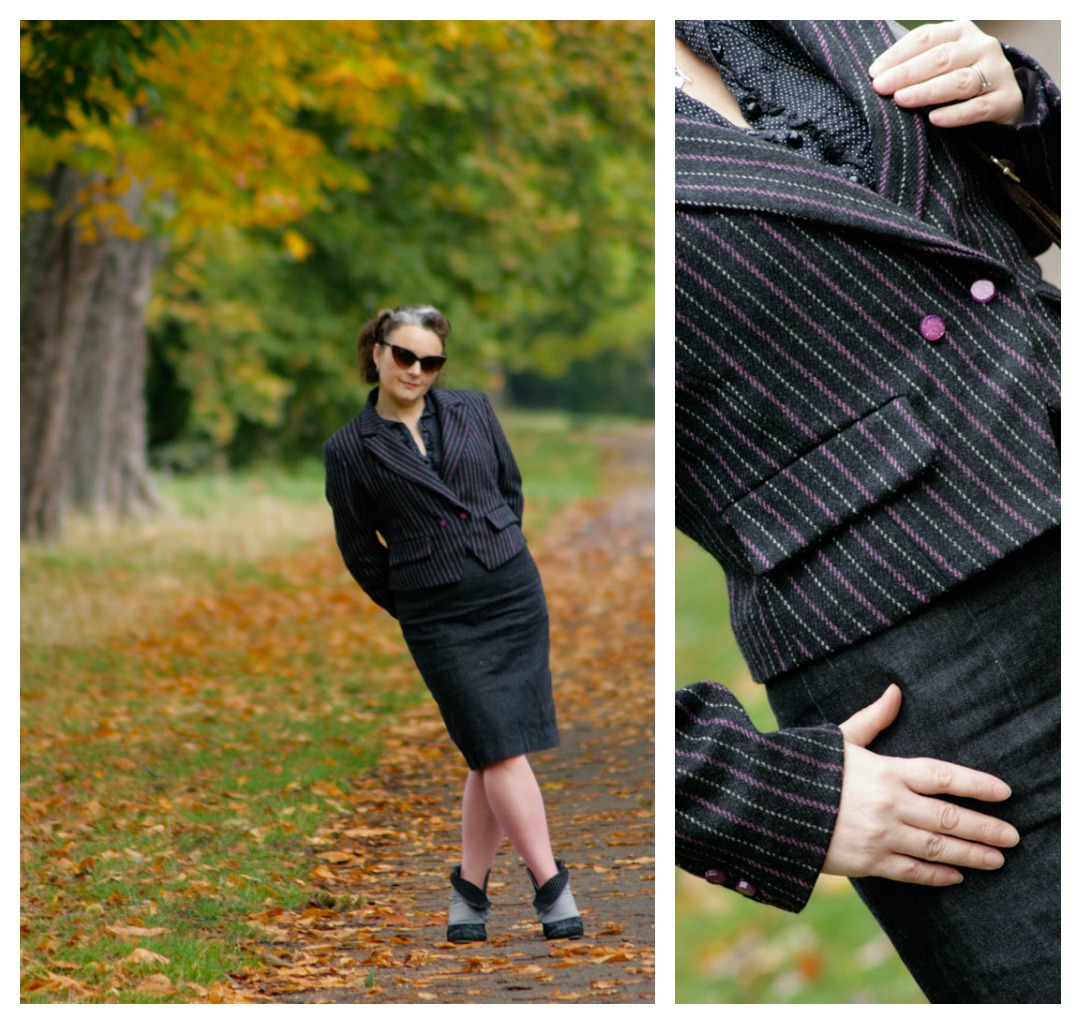
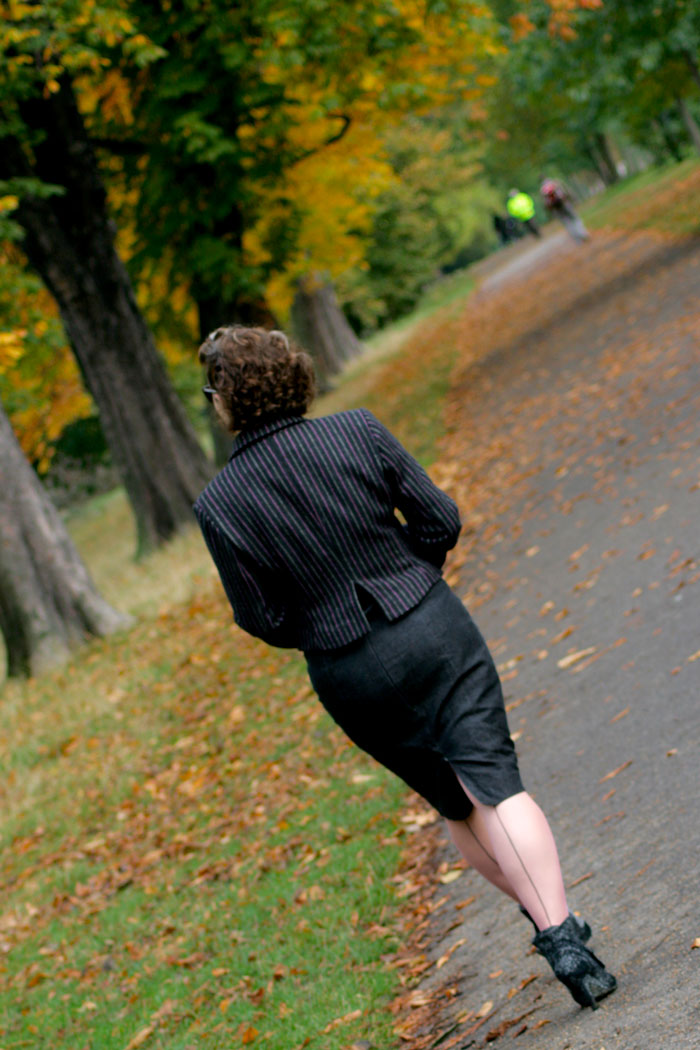
I will do a follow up post with all the niggly construction bits but for now I am so happy to present the finished jacket that was kindly and so brilliantly shot by Mr Ooobop! today. Kensington Gardens provided an amazing autumnal backdrop, despite the lack of sunshine and we had a lovely stroll while Little Miss Ooobop! went to a bowling party at All Star Lanes.
These were taken at the Italian Fountains near Lancaster Gate. It was lovely and misty but still the colours of the trees were beautiful.
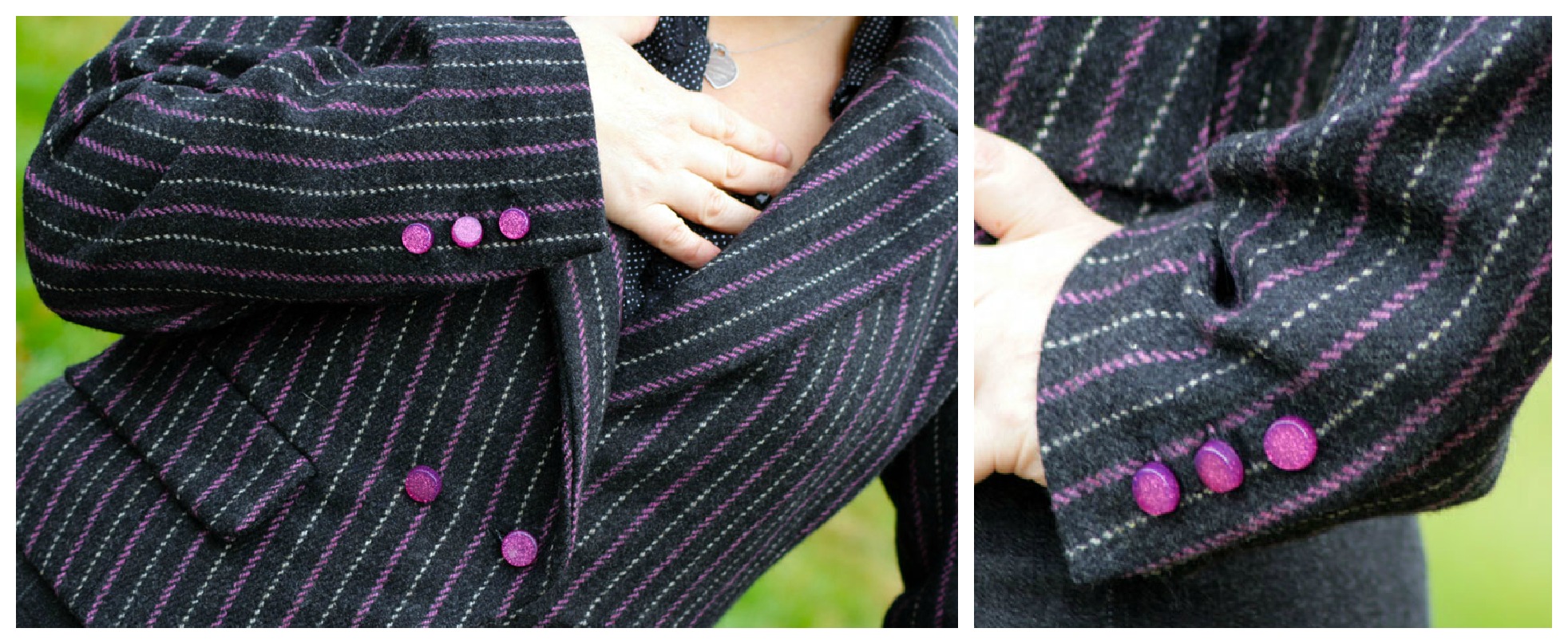
Despite the lack of blue sky, my trusty photographer was determined to make use of the gorgeous colours and he got some great detail shots too.
I’m so loving the sparkly raspberry buttons!
Besides being so happy to have finished and be wearing my jacket, today also proved how we take for granted all the beautiful open spaces that London has to offer. So many on our doorstep. Must get out more often!
Wishing you all a wonderful weekend. I’m off to find a tiny project!